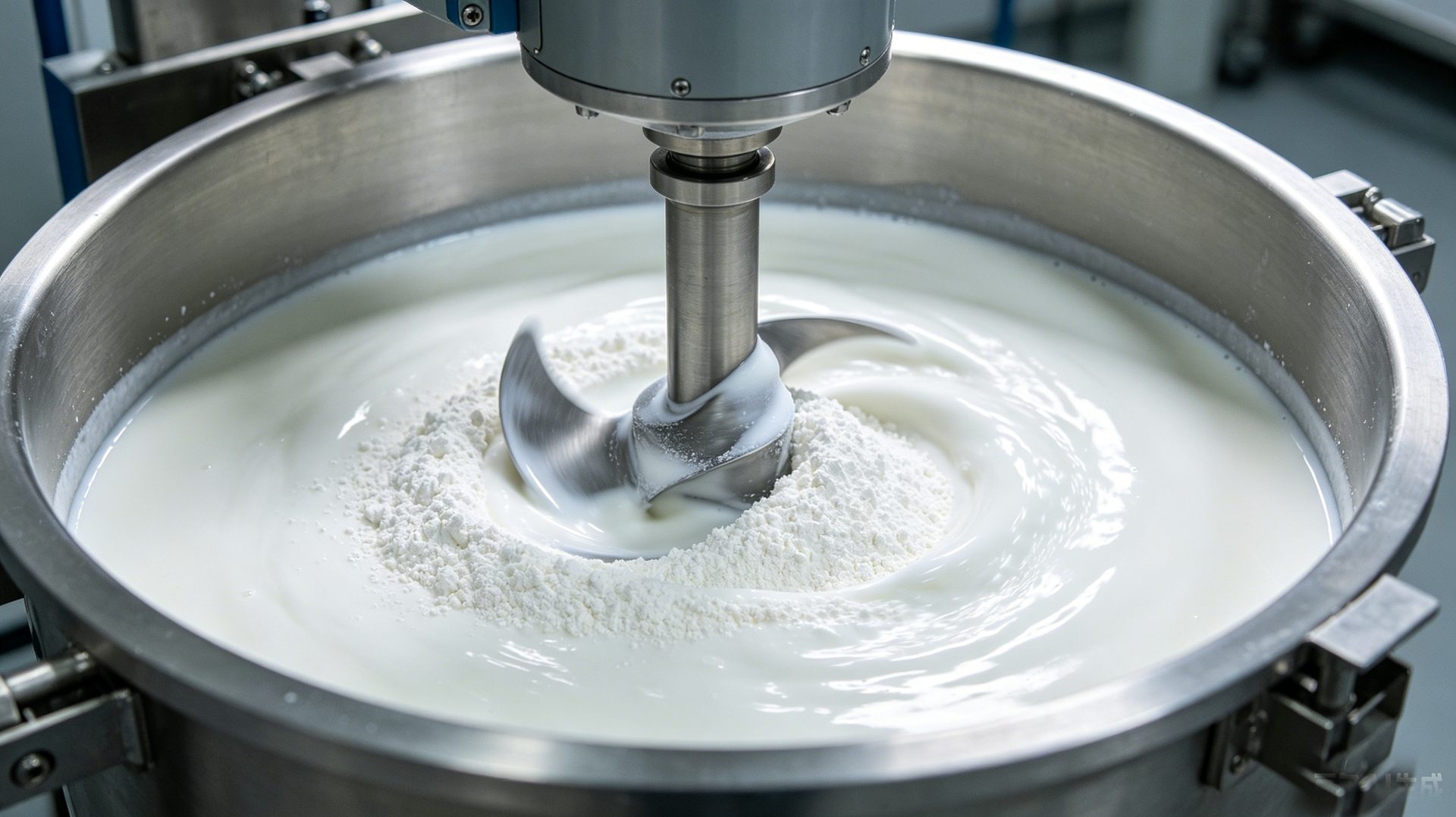
Key rule: Organoclay powder exists as stacks of thousands of bonded platelets. These stacks must be mechanically exfoliated into individual platelets — requiring sustained high shear (≥1,500 rpm for ≥15 min) and, in low-polarity systems, a polar activator to weaken interlayer forces. Improper dispersion is the most common cause of poor organoclay rheological performance in the field.
The Two Most Common Causes of Dispersion Failure
Based on customer technical inquiries we handle every week, there are two root causes behind almost all organoclay dispersion failures in the field:
- No pre-gel step (pre-gelation skipped). Organoclay needs time and shear to build its gel network. If you add the organoclay, mix briefly, and immediately proceed with the rest of the formulation, the gel network has not had time to fully form. The result is a product with insufficient viscosity and poor anti-settling performance — even though the organoclay itself is fine.
- No polar activator added. For conventional grades in low-to-medium polarity solvents (aromatic or aliphatic), the polar activator is not optional — it is the mechanism that weakens the interlayer forces and allows full platelet exfoliation. Skipping it means the platelets stay partially stacked, reducing effective gel area and gel strength by 40–60% compared to a properly activated dispersion.
One practical tip from our technical team: Before adding organoclay to the solvent, sieve the dry powder through a standard fine sieve to break any shipping lumps. This simple step ensures the powder enters the solvent as free-flowing particles and gives the high-shear disperser a better starting point. If sieving is not practical on your production line, compensate by extending mixing time by 5 minutes and increasing shear speed to the upper end of the recommended range.
Why Dispersion Method Matters
Organoclay that is not fully delaminated provides coarse agglomerates that cannot form the edge-face electrostatic gel network needed for thixotropy. Based on our testing: organoclay mixed at only 500 rpm (low shear) achieves a thixotropic index of 2.1–2.8 vs TI of 4.5–5.5 with correct 2,000 rpm high-shear dispersion at identical dosage. The difference is entirely in dispersion quality — not organoclay quality.
Method A: Polar Activator Dispersion
For grades: CP-34, CP-40, CP-982, CP-992 (optional), CP-250A
- Add organoclay to solvent/oil at room temperature. Ratio: typically 1–5% by weight on total formula.
- Add polar activator (95% ethanol or propylene carbonate) at 30–50% of organoclay weight (e.g., 1 g activator per 2–3 g organoclay).
- Mix at high shear: Use a Cowles dissolver, high-speed disperser, or rotor-stator mixer at 1,000–3,000 rpm for 10–15 minutes. Temperature should be 20–40°C.
- Rest period: Stop mixing and allow 5–15 minutes for gel network formation before proceeding.
- Proceed with formulation: Add resins, pigments, and other components normally.
Method B: Self-Activating (SA) Dispersion
For grades: CP-180B, CP-992 (SA mode)
- Add organoclay directly to solvent or oil phase — no polar activator required.
- Mix at high shear: 1,500–3,000 rpm for 15–20 minutes. Longer mixing time compensates for the absence of external activator.
- Rest period: Allow 10 minutes before further processing.
Method C: Water-Based Dispersion (CP-EW)
- Add CP-EW to water under agitation
- Mix at medium-high shear for 15–20 minutes
- No polar activator needed — water acts as the dispersion medium
- For cosmetic applications: disperse in the water phase before emulsification
Method D: Pre-Gel (Masterbatch) Method
When the full production batch cannot be dispersed at sufficient shear — large kettles, disperser capacity limits, or resins with poor wettability (epoxy, polyester, short-oil alkyd) — organoclay can first be built into a high-concentration "pre-gel paste" in a small portion of the solvent or oil, then blended into the main batch.
Typical pre-gel paste formula (by weight): solvent or oil ~87%, organoclay 8–10%, polar activator 3–4%.
- Combine the solvent/oil portion with organoclay powder and mix at high shear for ~10 minutes.
- Add the polar activator and continue mixing for ~5 minutes.
- Rest until a firm, uniform gel paste forms.
- Blend the pre-gel paste into the main batch at the target treat rate, mixing at medium-high shear until uniformly distributed.
Because the paste is a stable intermediate, it can be prepared ahead of time in dedicated batches and drawn down as needed — useful for production lines running multiple formulations from the same base organoclay grade.
| Aspect | Direct Addition (Methods A/B) | Pre-Gel Masterbatch (Method D) |
|---|
| Equipment | Full-batch high-shear disperser | Smaller high-shear mixer for the paste only |
| Best for | Standard batch sizes with adequate disperser capacity | Large batches, limited-shear equipment, or resins with poor wettability |
| Quality control | Gel quality checked only in the final batch | Paste gel quality can be checked before blending into the main batch |
| Workflow | Single step | Two steps, but the paste can be pre-made in advance and used across multiple batches |
Polar Activator Selection Guide
| Activator | Usage | Notes |
|---|
| 95% Ethanol | General purpose, paints, coatings | Most common, good efficiency |
| Propylene carbonate | High-solid coatings, greases | Low VOC, excellent performance |
| Acetone | Low-polarity systems | Fast evaporation, good for cold weather |
| Methanol | Industrial (not cosmetic) | High efficiency, toxicity concern |
Common Dispersion Problems
- Lumpy/grainy texture: Insufficient shear speed or time. Increase rpm or extend mixing.
- Poor gel / low viscosity: Too little activator, or activator added too late. Add activator immediately after organoclay addition.
- Viscosity too high: Over-activated or too high treat rate. Reduce organoclay addition or activator ratio.
- Gel won't form: Wrong grade for solvent polarity. Check the Product Finder for compatibility.
Frequently Asked Questions
How do you disperse organoclay?
(1) Add organoclay to solvent/oil before resin; (2) add polar activator — 95% ethanol at 30–50% of organoclay weight, or propylene carbonate at 20–30%; (3) mix at 1,500–3,000 rpm for 15–20 minutes (Cowles disperser); (4) rest 10–15 min for gel to build; (5) verify TI ≥ 4.0. For self-activating grades: skip activator, same mixing procedure.
What is the best polar activator for organoclay?
95% ethanol at 30–40% of organoclay weight — most common for coatings. Propylene carbonate at 20–30% — preferred for oil-based drilling fluids and greases (non-volatile). Acetone at 30–50% — high efficiency but very volatile, use in ventilated equipment. For most coatings, ethanol at 30–40% is the standard reliable choice.
Why is organoclay not dispersing properly?
Most common causes: (1) insufficient shear — use ≥1,500 rpm Cowles disperser for ≥15 min; (2) organoclay added to resin before solvent; (3) wrong activator dose — too little (<20% of OC weight) or too much (>60%, "activator poisoning"); (4) wrong grade for solvent polarity — check Product Finder; (5) temperature too low — below 15°C, extend mixing to 20–25 min.
Can organoclay be dispersed without an activator?
Yes — for self-activating grades (CP-180B, CP-APA, CP-MP10) or in high-polarity solvents (MEK, butyl acetate, ketone blends) where the solvent itself provides sufficient polarity. For conventional grades in aromatic or aliphatic solvents, activator is required for full performance.
What is the pre-gel (masterbatch) method for dispersing organoclay?
The pre-gel (masterbatch) method builds organoclay into a high-concentration paste in a small portion of the solvent or oil — typically solvent/oil ~87%, organoclay 8–10%, polar activator 3–4% by weight — before blending it into the main batch at the target treat rate. It suits large batches, equipment with limited high-shear capacity, and resins with poor wettability (epoxy, polyester, short-oil alkyd), and the paste can be pre-made in advance for use across multiple batches.
Related: How Organoclay Works · Product Finder · Technical Support