
Anti-Sagging Agent for Paint & Coatings

Organoclay prevents wet paint film from flowing on vertical surfaces after application — building a thixotropic yield point that holds the film in place, while collapsing instantly under brush, roller, or spray shear for smooth application and good leveling.
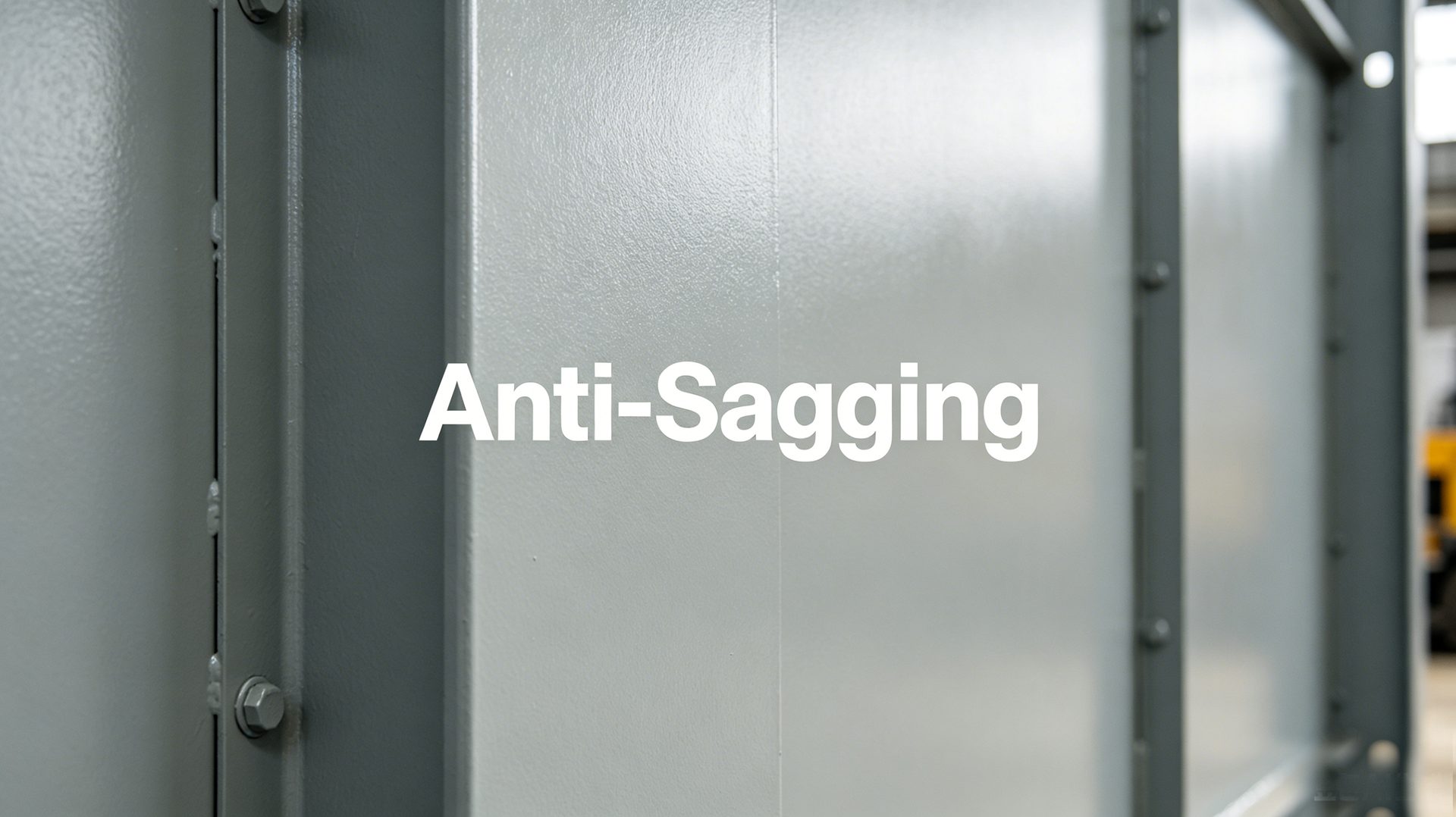
Organoclay anti-sagging agent — smooth even coating on vertical steel surface without drips

What is Paint Sagging?

Paint sagging (also called runs or curtaining) occurs when a freshly applied wet paint film flows downward on vertical surfaces under gravity before the film cures. Sagging is governed by the balance between gravitational stress (τ = ρ·g·h, proportional to film thickness) and the paint's yield point. When gravitational stress exceeds yield point, the film flows. In solvent-based industrial coatings, organoclay at 0.3–1.5 wt% builds a yield point of 3–15 Pa — sufficient to hold wet films up to 200 μm on vertical surfaces without flow.

Mechanism: How Organoclay Prevents Sagging

Organoclay works through thixotropic gel network formation — the same mechanism that provides anti-settling performance:

  1. During application (brush, roller, spray): High shear breaks the organoclay platelet network → viscosity drops 5–15× → paint flows freely, applies smoothly, levels well
  2. Immediately after application: Shear stops → network begins rebuilding through edge-to-face electrostatic interactions between exfoliated clay platelets
  3. Network recovery (5–30 seconds): Yield point builds rapidly to 3–15 Pa → exceeds gravitational stress on the wet film → film held in position → no runs or curtaining
  4. Through cure: As solvent evaporates and resin crosslinks, the film becomes self-supporting — organoclay contribution diminishes as mechanical strength builds
Key Takeaway: The time window between application and gel network recovery (5–30 seconds) is the critical anti-sag parameter. Organoclay recovers faster than polyamide wax or castor oil derivatives, which require cooling to solidify — making organoclay the preferred anti-sagging agent for elevated-temperature spray application and heat-accelerated cure systems.

Anti-Sagging Performance: Film Thickness vs. Required Yield Point

Wet Film Thickness Paint Density Gravitational Stress Required Yield Point Organoclay Dosage (CP-34)
50 μm (standard architectural)1.2 g/cm³0.6 Pa≥ 1.0 Pa0.2–0.3 wt%
100 μm (industrial protective)1.3 g/cm³1.3 Pa≥ 2.0 Pa0.3–0.5 wt%
150 μm (marine, anti-corrosion)1.4 g/cm³2.1 Pa≥ 3.5 Pa0.5–0.8 wt%
200 μm (high-build epoxy)1.5 g/cm³2.9 Pa≥ 5.0 Pa0.8–1.2 wt%
300 μm (zinc-rich primer, thick coat)1.8 g/cm³5.3 Pa≥ 8.0 Pa1.2–2.0 wt%

Grade Selection by Coating System

Coating System Recommended Grade Dosage Range Target TI (6/60 rpm)
Aromatic solvent (xylene, toluene) — alkyd, epoxyCP-34, CP-400.3–1.2 wt%4.0–7.0
Aliphatic + aromatic blendCP-10, CP-26, CP-1000.3–0.8 wt%3.5–6.0
High-solid / self-activating (no polar activator)CP-180B, CP-APA0.3–1.0 wt%4.0–6.5
Ketone / ester systems (MEK, butyl acetate)CP-APA, CP-MP0.3–0.8 wt%3.5–5.5
Transparent / clear coatingsCP-MPS, CP-EDS (≤10 μm)0.2–0.6 wt%3.0–4.5
Marine, thick-film anti-corrosionCP-34, CP-APA0.8–2.0 wt%5.5–8.0
Waterborne coatingsCP-EW0.5–1.5 wt%2.5–4.0

Comparing Anti-Sagging Agents

Additive Anti-Sagging Anti-Settling Recovery Speed Thermal Stability Transparency
OrganoclayExcellentExcellent5–30 sExcellent (to 180°C)Good–Excellent (fine grades)
Fumed silicaGoodGood10–60 sGoodPoor (hazy)
Polyamide waxGoodModerateSlow (requires cooling)Poor (melts <85°C)Poor
Hydrogenated castor oilModerateModerateSlowPoorPoor
HEUR (waterborne)ModerateModerate30–120 sGoodGood

Incorporation Method for Maximum Anti-Sag Performance

  1. Add organoclay to solvent phase before pigments or resin — ensures unobstructed gel network formation
  2. Add polar activator for conventional grades: 95% ethanol at 30–50% of organoclay weight. Omit for self-activating grades (CP-180B, CP-APA)
  3. High-shear dispersion at 2,000–3,000 rpm for 15–20 minutes — ensures full exfoliation of clay platelets
  4. Rest 10–15 minutes before adding remaining components — allows initial gel network to form
  5. Verify anti-sag performance: apply 150 μm wet film on vertical panel — no sag after 30 minutes at 25°C indicates correct dosage

Frequently Asked Questions

What is an anti-sagging agent in paint?
An anti-sagging agent prevents applied wet paint from flowing down vertical surfaces before it cures. It works by building a yield point (structured viscosity at rest) that exceeds the gravitational stress of the wet film. In solvent-based industrial coatings, organoclay is the standard anti-sagging agent — building yield points of 3–15 Pa at 0.3–1.5 wt% dosage, sufficient for wet films up to 200+ μm on vertical surfaces.
What causes paint to sag on vertical surfaces?
Sagging occurs when gravitational stress on the wet film (τ = density × g × film thickness) exceeds the paint's yield point. Thick films, high-density pigment systems, elevated temperature (reduces vehicle viscosity), and fast-evaporating solvents all increase sag tendency. Organoclay at 0.5–1.0 wt% builds yield points of 5–12 Pa — well above the gravitational stress of most industrial coating formulations at standard film build.
How does organoclay prevent paint sagging?
Organoclay collapses its platelet gel network under application shear (spray, brush, roller) — paint flows freely and levels well. Within 5–30 seconds of shear stopping, the network rebuilds and establishes a yield point that holds the wet film on vertical surfaces against gravity. This recovery is faster than wax-based anti-sagging agents (which require cooling to solidify), making organoclay more effective for elevated-temperature spray application.
What is the difference between anti-sagging and anti-settling?
Anti-settling suspends dense pigments in stored liquid paint (weeks/months at rest). Anti-sagging holds the applied wet film on vertical surfaces (minutes after application). Organoclay provides both simultaneously — the same thixotropic gel network that prevents pigment settling during storage also prevents wet film from running after application. This dual function eliminates the need for separate additives. Anti-Settling Guide →
Which organoclay grade is best for anti-sagging in paint?
By solvent system: aromatic (xylene, toluene) → CP-34 or CP-40; aliphatic blends → CP-10, CP-26; high-solid or self-activating → CP-180B, CP-APA; ketone/ester → CP-APA, CP-MP; clear coatings → CP-MPS, CP-EDS (≤10 μm); waterborne → CP-EW. For thick-film marine or anti-corrosion coatings requiring TI ≥ 6.0, use CP-34 at 1.0–2.0 wt% with ethanol activator.
What dosage of anti-sagging agent is needed for thick-film coatings?
For thick-film coatings (100–300 μm WFT): 0.5–0.8 wt% CP-34 for marine coatings; 0.8–1.2 wt% for anti-corrosion primers with heavy pigment (BaSO₄, Fe₂O₃); 1.2–2.0 wt% for zinc-rich primers and high-build epoxy floor coatings. Target TI ≥ 5.5 (measured at 6/60 rpm, Brookfield). Verify with 150 μm wet film vertical panel test — zero flow after 30 minutes at 25°C is the acceptance criterion.

Related pages: Anti-Settling Agent Guide · Viscosity Control · Organoclay for Paint & Coatings · What is a Thixotropic Agent? · How to Prevent Pigment Settling

Solve Your Anti-Sagging Problem — Free Samples & Technical Advice

Tell us your solvent system, film build target, and current sagging issue — we'll recommend the right grade and dosage, and ship free samples within 48 hours.