Instant Connect

Scan to connect via WhatsApp or WeChat
The primary viscosifier and gelling agent in oil-based mud (OBM) and synthetic-based mud (SBM) — builds yield point and thixotropic gel strength for cutting transport, barite sag prevention, and wellbore stability at temperatures exceeding 200°C.
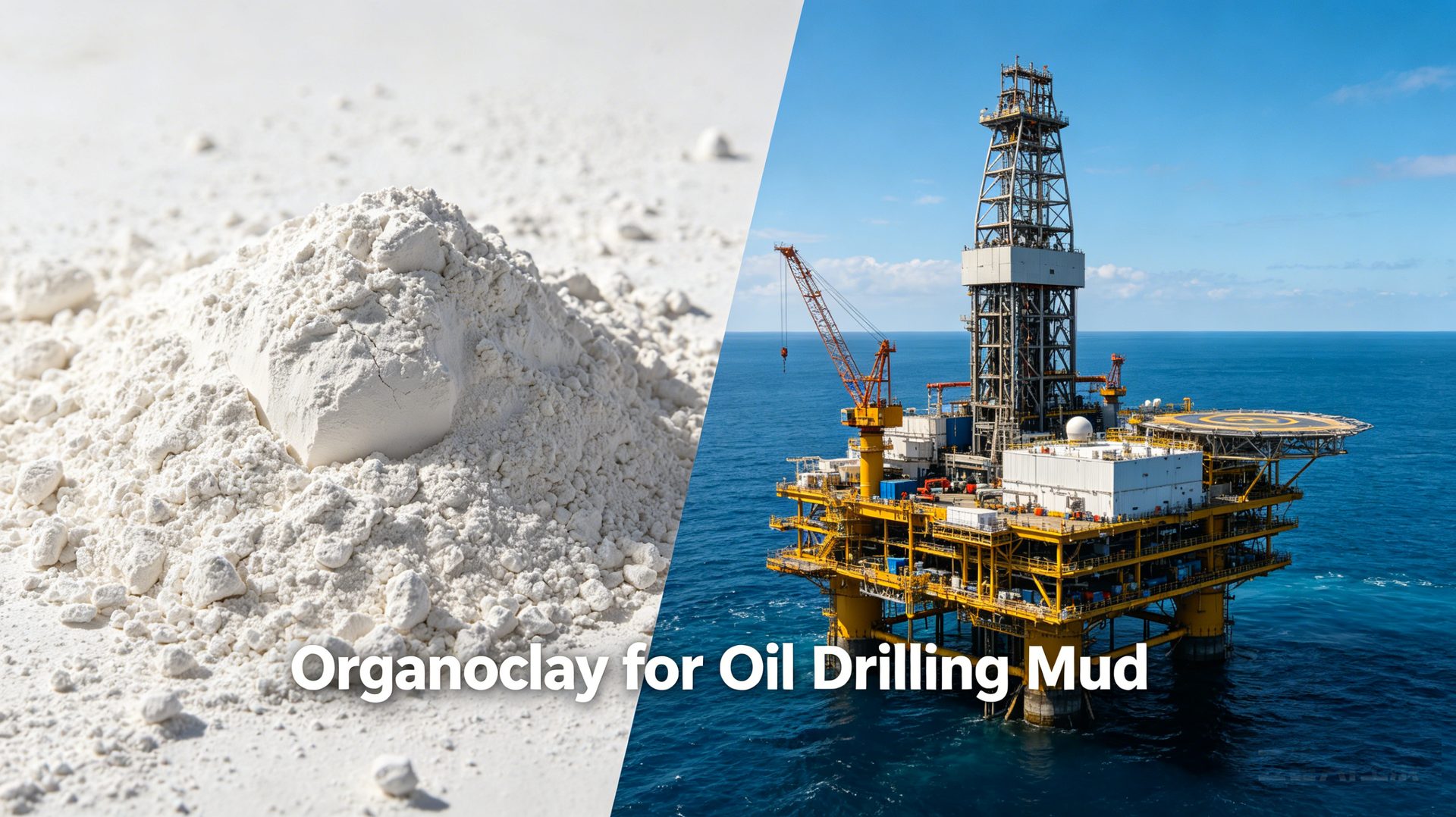
Our drilling-grade organoclay is actively used by customers in Canada, Russia, Kuwait, UAE, Turkmenistan, and Nigeria — covering both conventional oil fields and technically demanding deepwater and HPHT well programs. Beyond the standard high-performance/cost-effective grades for conventional OBM, we supply high-temperature high-pressure (HTHP) stable organoclay grades specifically engineered for wells where standard grades would degrade under sustained downhole conditions.
When customers ask how our grades compare to internationally known reference products, we don't just claim equivalence — we have conducted head-to-head comparative testing in our lab against the major benchmark grades. That means when you ask for our recommendation, we can point you directly to the CP grade that matches your target rheology profile, backed by data. We provide the grade and COA; you test it in your system. That's the only way to make a confident supply decision.
The three parameters drilling fluid engineers tell us they care about most: yield point (YP) — the suspension power that carries cuttings to surface; thixotropy — gel strength that holds cuttings during static periods; and electrical stability (ES) — the emulsion quality indicator that protects formation and ensures OBM integrity. Our grades are characterized against all three.
| Function | Mechanism | Operational Impact |
|---|---|---|
| Viscosity building | Platelet gel network raises yield point and gel strength | Drill cuttings transported from bit to surface efficiently |
| Barite sag prevention | Static gel network suspends barite (SG 4.2) against gravity | Prevents density inversion in deviated wells; reduces well control risk |
| Thixotropic behavior | Low viscosity under pump pressure; rapid gel recovery when pumps stop | Lower ECD during circulation; safe static gel strength during connections |
| HPHT stability | Inorganic platelet base stable to ~200°C; outperforms polymer viscosifiers at high temperature | Maintains rheology in deep, high-temperature wells |
| Flat gel profile | Organoclay tends to produce flat gels (10-min/10-s ratio <2.0) | Easier circulation restart; reduced swabbing and surge pressure |
| Filter cake quality | Platelet alignment in filter cake improves cake integrity | Reduced fluid loss into formation; improved wellbore stability |
Drilling fluid rheology is measured per API RP 13B-2 at 600, 300, 200, 100, 6, and 3 rpm. Organoclay primarily controls yield point and gel strengths:
| Parameter | Definition | Typical OBM Target | Organoclay Effect |
|---|---|---|---|
| Plastic Viscosity (PV) | High-shear viscosity; reflects solids content | 15–40 mPa·s | Minor increase |
| Yield Point (YP) | Stress to initiate flow; cutting transport indicator | 10–25 Pa | Primary control |
| 10-s Gel Strength | Gel strength after 10 seconds rest | 5–15 Pa | Primary control |
| 10-min Gel Strength | Gel strength after 10 minutes rest | 8–25 Pa | Primary control |
| YP/PV Ratio | Cutting transport efficiency index | >1.0 | Improved — YP rises more than PV |
| Base Oil Type | Polarity | Recommended Grade | Activator |
|---|---|---|---|
| Diesel (No. 2) | Low | CP-34, CP-40, CP-24B | Required (ethanol or PC) |
| Mineral oil | Low | CP-34, CP-EL, CP-GL | Required |
| Internal olefin (IO) / LAO | Low–medium | CP-34, CP-40 | Required |
| Linear paraffin | Non-polar | CP-EL, CP-GL | Required |
| Low-toxicity mineral fluid (LTMF) | Low | CP-34, CP-40 | Required |
| Synthetic ester | Medium–high | CP-40, CP-APA | Reduced or none |
| Grade | LOI (1000°C) | Moisture | Fineness (<74 μm) | Polarity Range | API Testing |
|---|---|---|---|---|---|
| CP-34 | 28–30% | ≤3.5% | ≥98% | Low to medium-high | ✓ Available |
| CP-40 | 28–30% | ≤3.5% | ≥98% | Low to medium-high | ✓ Available |
| CP-24B | <29% | ≤3.5% | ≥98% | Low to medium | ✓ Available |
| CP-26 | 26–29% | ≤3.5% | ≥98% | Non-polar to medium | ✓ Available |
| CP-EL | 28–32% | ≤3.5% | ≥98% | Intermediate to low | ✓ Available |
| CP-GL | 29–32% | ≤3.5% | ≥98% | Intermediate to low | ✓ Available |
All drilling grades are tested per API 13A Section 14. Batch COA with rheological performance data provided with every shipment. SGS and Intertek third-party verification available on request.
Critical rule: Add organoclay before emulsifiers. Emulsifier molecules compete with the polar activator for clay surface sites — adding emulsifier first reduces organoclay gel strength by 20–40%.
| Activator | Dosage (% by wt of organoclay) | Best Use Case |
|---|---|---|
| 95% Ethanol | 30–50% | General purpose; most widely available |
| 95% Methanol | 30–50% | Slightly more effective in very low-polarity base oils |
| Propylene carbonate (PC) | 25–40% | Non-volatile; preferred in high-temperature or tropical operations |
| PC/water 95:5 | 25–40% | Enhanced activation in aliphatic or very low-polarity systems |
| Mud Type | Mud Weight | Dosage | Target YP | Target 10-min Gel |
|---|---|---|---|---|
| Low-density OBM | <1.3 sg | 5–10 kg/m³ (1.8–3.5 lb/bbl) | 8–15 Pa | 8–15 Pa |
| Medium-density OBM | 1.3–1.8 sg | 8–15 kg/m³ (2.8–5.3 lb/bbl) | 10–20 Pa | 12–20 Pa |
| High-density OBM | >1.8 sg | 12–20 kg/m³ (4.2–7.0 lb/bbl) | 15–25 Pa | 15–25 Pa |
| HPHT applications | Any | 15–25 kg/m³ | Per engineering spec | Per engineering spec |
Increase dosage by 20–30% for: HPHT wells (>150°C downhole); high-angle or extended-reach wells (>60° inclination); heavy barite loading; long anticipated static periods.
Based on HPHT aging tests (16 hours at 150°C, 345 bar), CP-34 and CP-40 retain >75% of initial yield point and gel strength. Organoclay is thermally stable to ~200°C — superior to cellulose, starch, and most synthetic polymer viscosifiers.
Barite sag (density settling of barite, SG 4.2, in deviated wellbores during static periods) is a major OBM operational risk. Organoclay is the primary prevention mechanism:
| Problem | Root Cause | Solution |
|---|---|---|
| Low YP / weak gel after mixing | Under-mixing; emulsifier added before OC; insufficient activator | Extend mixing to 15 min at full pump speed; add OC before emulsifier; verify activator at 30–50% of OC weight |
| Rheology loss at temperature | HPHT degradation; insufficient dosage for well conditions | Increase dosage 20–30%; conduct HPHT aging test at target temperature before deployment |
| Barite sag in deviated section | Gel strength below sag threshold; long static period | Increase OC to achieve 10-min gel ≥15 Pa at mud weight; verify with static sag test |
| Excessive viscosity / high ECD | Organoclay overdose; grade mismatch | Reduce OC dose by 15%; confirm grade matches base oil polarity; treat with thinner if needed |
| Poor emulsion stability (ES <400V) | Wrong addition sequence; emulsifier competing with OC activation | Add OC before emulsifier; re-verify mixing sequence; check emulsifier-organoclay compatibility |
Recommended grades for oil-based drilling fluids: CP-982 (standard OBM, diesel/mineral oil) · CP-992 (synthetic & low-BTEX, rapid yield) · CP-31 (self-activating, low shear, cold climate) · CP-2 (amine-treated, diesel OBM) · CP-34 (dual-use coatings + drilling)
Related pages: Water-Based Drilling Additives · Viscosity Control in OBM · Viscosity Control Guide · HTHP Stability · What is a Viscosifier?
API 13A tested. Batch COA provided. Tell us your base oil type and mud weight — we confirm the right grade and ship free samples within 48 hours.
We reply within 24 hours on business days.
Thank you! Your inquiry has been received.
We'll get back to you within 24 hours.
WeChat ID
0086-13185071071