
How Organoclay Works

The platelet gel network mechanism, polar activator role, dispersion procedure, and thixotropic behavior — technical explanation for formulators and engineers.
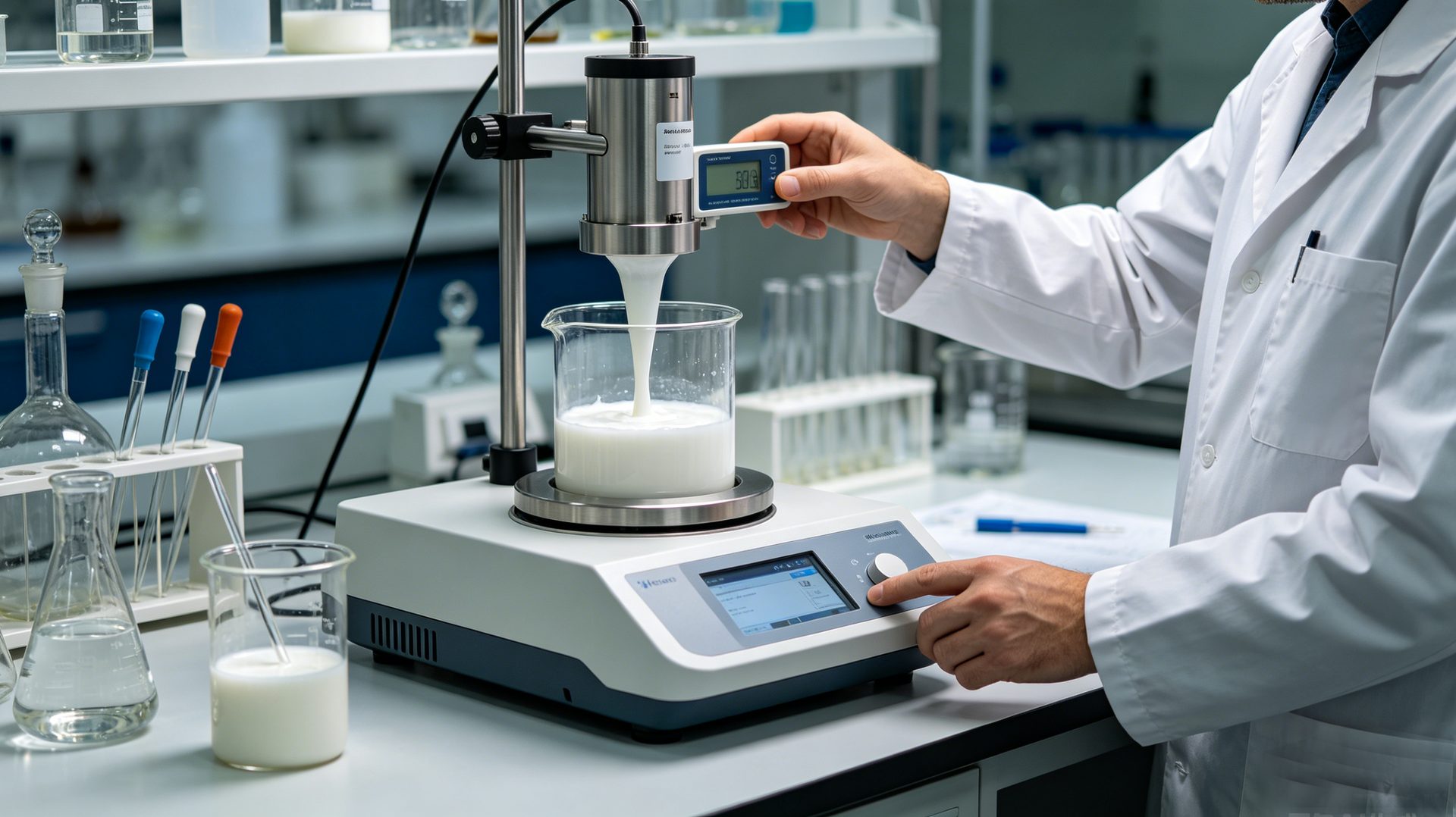
Organoclay rheology testing — scientist measuring viscosity and gel strength of organophilic clay dispersion

The Gel Network Mechanism

How organoclay works: Organoclay platelets (~1 nm thick, 200–500 nm wide) dispersed under high shear in organic solvent or oil form a three-dimensional "house-of-cards" network through edge-to-face electrostatic interactions. At rest: intact network → high yield point → pigments suspended, film held. Under shear: network collapses → low viscosity → easy flow. After shear: network rebuilds in 5–30 seconds → viscosity returns.

The mechanism in four sequential steps:

  1. Wetting: Solvent and polar activator molecules enter between the platelet stacks, reducing interlayer van der Waals attraction
  2. Exfoliation: High shear (1,500–3,000 rpm) mechanically separates stacked platelet aggregates into individual sheets
  3. Network formation: At rest, edge surfaces (slightly positive) interact electrostatically with face surfaces (negative) of adjacent platelets — forming an interlocked three-dimensional "house-of-cards" scaffold
  4. Thixotropic response: Applied shear overcomes the electrostatic bonds → network collapses → viscosity drops. When shear stops → bonds reform → gel structure rebuilds (5–30 seconds)

Role of the Polar Activator

In low-to-medium polarity solvent systems, the organic solvent alone cannot penetrate efficiently between organoclay platelet stacks. A polar activator bridges this gap:

ActivatorDosage (% of OC weight)Best For
95% Ethanol30–50%Aromatic and medium-polarity systems (general purpose)
Propylene carbonate (PC)20–30%Low-polarity systems; non-volatile (preferred for OBM)
95% Methanol30–50%Very low-polarity aliphatic base oils
Acetone30–50%Wide range; highly volatile — use in ventilated equipment
None (self-activating grades)CP-180B, CP-APA, CP-MP10 — PC pre-coated during manufacture
Activator Dosage Warning:
  • Too little (below 20% of OC weight): incomplete platelet exfoliation → TI 40–60% below maximum
  • Optimal (30–50% ethanol; 20–30% PC): maximum gel network → highest TI
  • Too much (above 60%): "activator poisoning" → platelet over-wetting → network cannot form → TI collapses

How to Disperse Organoclay — Step by Step

Conventional Grades (CP-34, CP-40, CP-24B, CP-EL, CP-GL)

  1. Add organoclay to the solvent phase first — before resin, binder, or pigments. Clay must contact solvent before resin polymers can impede platelet wetting.
  2. Add polar activator — 95% ethanol at 30–50% of organoclay weight, or propylene carbonate at 20–30%
  3. High-shear mix at 1,500–3,000 rpm for 15–20 minutes — use a high-speed disperser or Cowles blade. Low-speed mixing is the most common field cause of poor gel performance.
  4. Rest 10–15 minutes before measuring viscosity or adding other components
  5. Verify thixotropic index — target ≥ 4.0 for most coatings (measured as viscosity at 6 rpm ÷ viscosity at 60 rpm)

Self-Activating Grades (CP-180B, CP-APA, CP-MP10)

  1. Add organoclay directly to solvent or oil phase — no activator needed
  2. Mix at 1,500–2,500 rpm for 15–20 minutes
  3. Self-activating grades can also be post-added after grinding for viscosity correction

Troubleshooting Dispersion Problems

ProblemLikely CauseSolution
Low TI / weak gel after mixingInsufficient shear; added to resin before solvent; wrong activator doseExtend mixing to 20 min at ≥2,000 rpm; add organoclay to solvent first; verify activator at 30–50% of OC weight
Gel forms but then weakensExcess activator ("activator poisoning")Reduce activator to 30–40% of OC weight; prepare fresh batch
No gel in low-polarity (aliphatic) systemGrade not matched to polarity; no activator or wrong activatorSwitch to CP-EL or CP-GL; use propylene carbonate/water (95:5) as activator
Gel forms but hazy in clear coatingCoarse particle grade; incomplete dispersionSwitch to ≤10 μm grade (CP-MP, CP-MPS); extend mixing to 25 min at 2,500 rpm
Gel deteriorates at high temperatureAbove 180°C modifier degradation; surfactant interferenceIncrease dosage 20–30% for HPHT; add surfactants after organoclay activation

Frequently Asked Questions

How does organoclay work as a rheology modifier?
Organoclay forms a thixotropic "house-of-cards" gel network through edge-to-face electrostatic interactions between exfoliated clay platelets. At rest: network intact → high yield point → particles suspended, film held. Under shear: network breaks → low viscosity → easy flow. After shear: network rebuilds in 5–30 seconds. This reversible gel mechanism makes organoclay the standard rheology modifier for solvent-based coatings, oil-based drilling fluids, and lubricating greases. What is organoclay? →
What is the role of polar activator in organoclay dispersion?
In low-to-medium polarity solvents, the polar activator (ethanol at 30–50% of organoclay weight, or propylene carbonate at 20–30%) intercalates between platelet stacks, weakening interlayer van der Waals forces and enabling high shear to exfoliate them into individual platelets. Without activator in low-polarity systems: ~40–60% of maximum performance. Excess activator (>60%): "activator poisoning" — gel collapses. In high-polarity solvents (ketones, esters), activator is often not required.
Why does organoclay need high-shear mixing?
Organoclay powder exists as stacks of thousands of bonded platelets. These stacks must be mechanically exfoliated into individual sheets before the gel network can form. This requires sustained high shear: 1,500–3,000 rpm for 15–20 minutes. Low-speed mixing wets the particles but does not achieve full delamination — resulting in thixotropic index 50–70% lower than achievable with correct high-shear dispersion. A Cowles disperser or equivalent high-speed mixer is required.
How long does organoclay gel take to form after mixing?
Initial gel forms within 2–5 minutes after mixing stops. Maximum gel strength (thixotropic index) is reached after 10–15 minutes rest. Always allow at least 10 minutes before measuring viscosity or adding other components. In cold conditions (<15°C), allow 20–30 minutes for full gel development before measurement.
What happens if too much polar activator is added?
"Activator poisoning" — excess activator (>60% of organoclay weight for ethanol) over-wets the platelet surfaces, disrupting the edge-face electrostatic interactions needed for network formation. The result is a dramatic drop in viscosity and thixotropic index — the gel may appear to have formed but has very low strength. If this occurs, the batch cannot be corrected by adding more organoclay — prepare a fresh dispersion with corrected activator dosage.
Why does organoclay not work in water?
Standard solvent-based organoclay is modified with long-chain quaternary ammonium cations (DMDA) that make the clay surface hydrophobic and organophilic. Water cannot intercalate between these organically modified platelet layers — the clay does not disperse or swell in aqueous systems. For water-based formulations, water-dispersible organoclay grades must be used. Water-based organoclay →

Related pages: What is Organoclay? · What is a Thixotropic Agent? · Step-by-Step Dispersion Guide · Viscosity Control Solutions · Product Finder

Get Dispersion Guidance from Our Application Engineers

Tell us your solvent system and target rheology — we'll recommend the right grade and provide sample with step-by-step dispersion protocol.