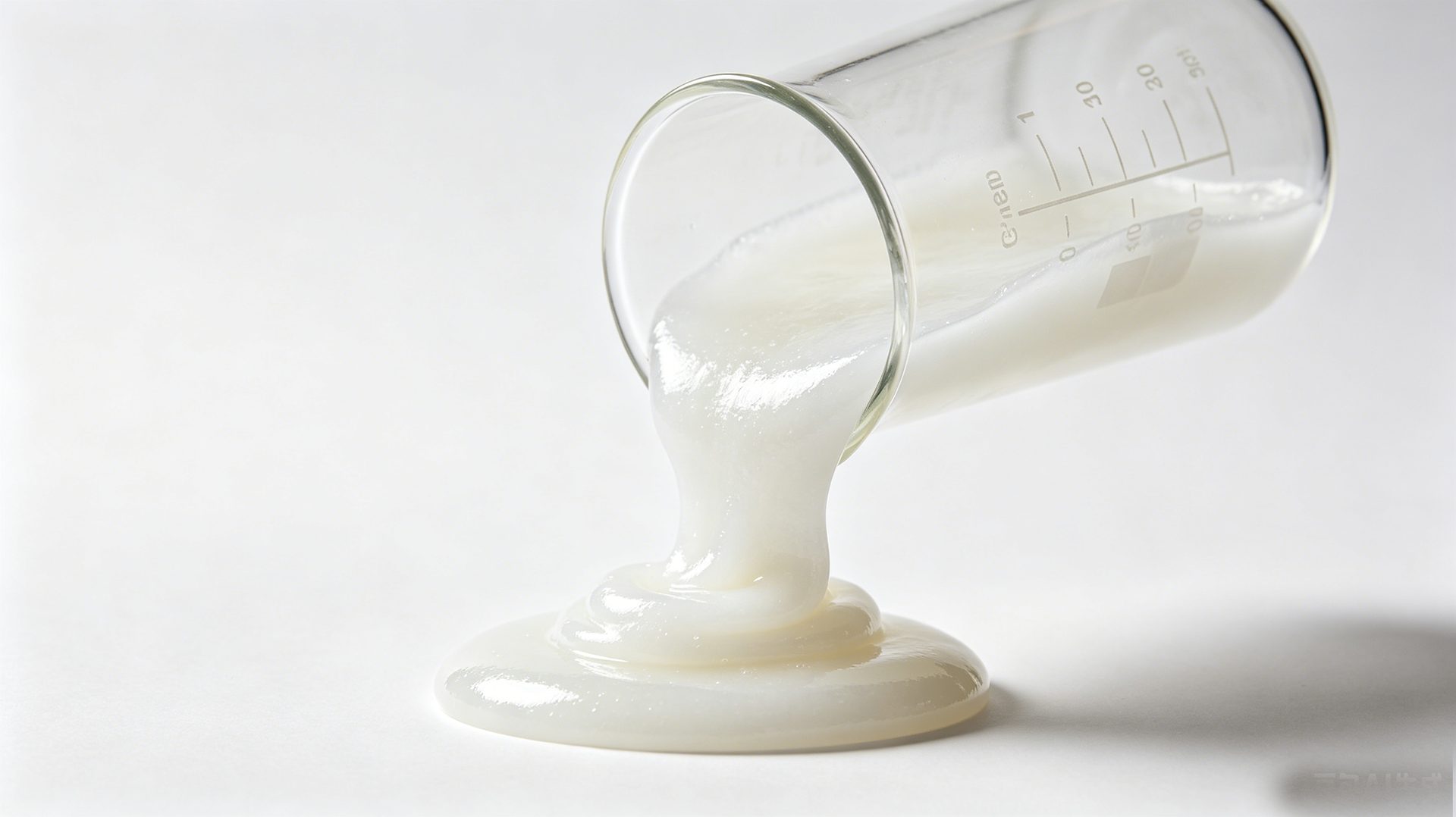
What is Thixotropy?
Thixotropy: A time-dependent, reversible decrease in viscosity under applied shear stress, followed by gradual viscosity recovery when shear is removed. A thixotropic material is gel-like at rest (high viscosity), flows under mechanical shear (low viscosity), and recovers its gel structure in seconds to minutes after shear stops. Quantified by thixotropic index (TI) = viscosity at 6 rpm ÷ viscosity at 60 rpm. Organoclay in coatings: TI 3–8.
Practical example: A thixotropic paint stored in a can has high viscosity (gel state) — pigments are suspended and the paint doesn't drip from a brush. During brushing (high shear), viscosity drops and the paint flows easily. After application (shear removed), viscosity recovers in seconds — the paint stays where applied and doesn't sag on vertical surfaces.
Thixotropic Agent Definition
A thixotropic agent is an additive that imparts thixotropic behavior to a formulation. Thixotropic agents work by building reversible internal structure (gel networks, particle associations, or entangled polymer chains) that provides viscosity at rest and breaks down under shear.
Common Thixotropic Agents
| Agent | Type | Best For |
|---|
| Organoclay | Modified clay mineral | Solvent-based systems, oil-based drilling fluids, greases |
| Fumed silica | Synthetic silica | Coatings, adhesives, waterborne systems |
| Hydrogenated castor oil | Wax | Paints, inks (moderate temperature) |
| Polyamide wax | Wax | Solvent coatings, inks |
| HASE / HEUR polymers | Associative thickener | Waterborne coatings |
Why Organoclay is a Preferred Thixotropic Agent
- Permanent thixotropy — inorganic structure is not degraded by heat or UV
- Broad solvent compatibility (aromatic, aliphatic, mineral oil, synthetic oil)
- Synergistic with fumed silica for enhanced performance
- Effective at low treat rates (0.3–2%)
- Chemically inert — does not react with resins or binders
Frequently Asked Questions
What are thixotropic agents?
Thixotropic agents induce time-dependent shear-thinning behavior in liquid formulations. Common types: organoclay (solvent-based and oil-based systems — platelet gel network); fumed silica (coatings and adhesives — hydrogen bonding network); hydrogenated castor oil (solvent coatings at moderate temperature — wax crystal network, melts above 85°C); polyamide wax (aliphatic solvent inks); HEUR/HASE polymers (waterborne coatings — hydrophobic association). Organoclay is dominant for solvent-based industrial coatings and oil-based drilling fluids.
What is the purpose of a thixotropic agent?
Three simultaneous purposes: (1) anti-settling at rest — gel structure suspends dense pigments during storage; (2) easy application under shear — gel collapses for normal flow and leveling; (3) anti-sagging after application — gel rebuilds in 5–30 seconds, holding the applied film. One thixotropic agent (organoclay at 0.3–1.5 wt%) addresses all three simultaneously in solvent-based coatings.
Viscosity control guide → What does thixotropic mean?
Thixotropic means a material becomes less viscous when sheared and gradually recovers high viscosity when shear stops — time-dependent and reversible. The thixotropic index (TI = viscosity at 6 rpm ÷ viscosity at 60 rpm) quantifies this. TI 1.0 = Newtonian (no thixotropy); TI 4.0–8.0 = strongly thixotropic (typical organoclay coating). Higher TI = better anti-settling and anti-sagging performance.
What is the difference between thixotropic and pseudoplastic?
Pseudoplastic (shear-thinning): immediate viscosity drop when shear rate increases; instant recovery when shear stops — no time lag. Thixotropic: time-dependent response — viscosity decreases gradually under sustained shear and recovers gradually after shear stops (seconds to minutes). Most organoclay-based systems are both pseudoplastic (instant shear response) and thixotropic (time-dependent full gel recovery).
Is organoclay a thixotropic agent?
Yes. Organoclay builds a "house-of-cards" platelet gel network — the classic thixotropic mechanism. TI values of 3–8 in solvent-based coatings at 0.3–1.5 wt%. Advantages over wax thixotropes: stable to 180°C (wax melts at 60–85°C), not affected by temperature cycling, dual anti-settling and anti-sagging in one additive.
How organoclay works → Related: What is Organoclay? · Viscosity Control Solutions · Organoclay vs Fumed Silica