Instant Connect

Scan to connect via WhatsApp or WeChat
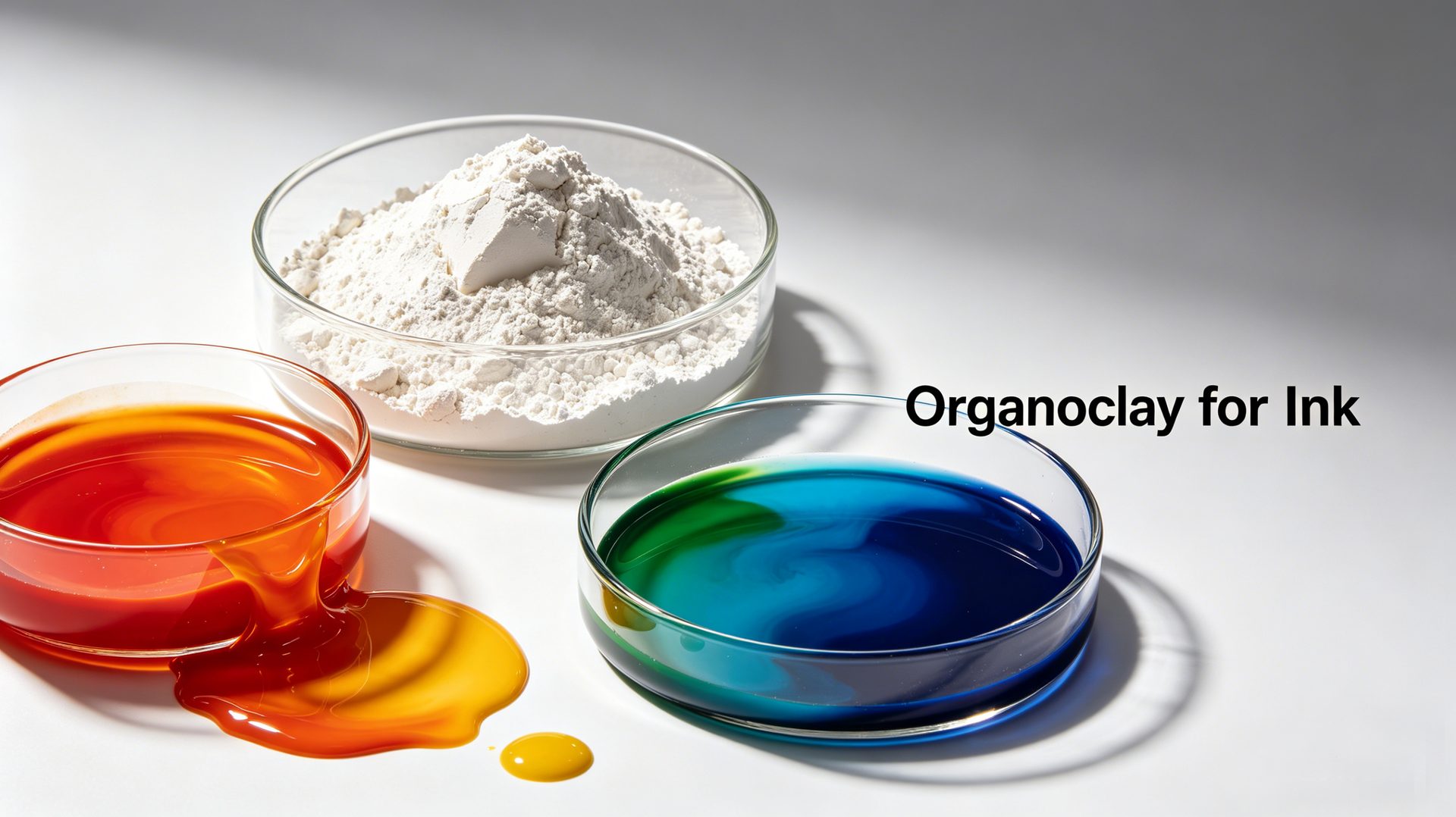
Thixotropic rheology modifier for solvent-based and oil-based printing inks — prevents pigment hard-settling in storage, controls ink body and tack, and reduces misting at high press speeds in offset, gravure, and screen printing.
| Function | Mechanism | Print Quality Impact |
|---|---|---|
| Anti-settling | Platelet gel network suspends dense pigments at rest | Consistent color strength; no hard-cake in can; stable ink fountain |
| Body / tack control | Gel structure builds low-shear viscosity (body) and controls tack profile | Clean ink transfer; predictable dot gain; reduced picking and setting time |
| Anti-misting | Higher ink body raises minimum stress for filament breakup; more cohesive ink film | Reduced ink fly at high web speeds; cleaner pressroom; less substrate contamination |
| Flow and leveling | Thixotropic recovery after nip allows ink to level on substrate before gelling | Smooth print, good gloss, defined dot edges |
| Ink Type | Base System | Organoclay Application | Priority |
|---|---|---|---|
| Offset / lithographic inks | Vegetable oils, mineral oils, aliphatic solvents | Anti-misting, body, anti-settling | High |
| Gravure inks | Solvent-based (toluene, MEK, ethyl acetate) | Anti-settling, thixotropy | High |
| Screen printing inks | Solvent / UV monomer | Strong thixotropy, body, anti-settling | High |
| Letterpress inks | Oil-based | Body control | Moderate |
| Flexographic inks (solvent) | Solvent-based | Anti-settling, low thixotropy | Moderate |
| UV-curable inks | Acrylate monomers (non-polar to medium) | Thixotropy, anti-settling | Moderate |
| Ink System | Typical Base | Recommended Grade | Dosage |
|---|---|---|---|
| Oil-based offset / litho | Vegetable oil, mineral oil, aliphatic | CP-34, CP-40, CP-EL, CP-GL | 0.3–1.2 wt% |
| Aromatic solvent inks | Toluene, xylene | CP-10, CP-10A, CP-34, CP-40 | 0.3–1.0 wt% |
| Ketone / ester inks | MEK, ethyl acetate | CP-APA, CP-MP, CP-EDS | 0.3–0.8 wt% |
| Alcohol-containing inks | Ethanol / propanol blends | CP-APA, CP-MP | 0.3–0.8 wt% |
| Screen printing (solvent) | Medium-polarity solvents | CP-10, CP-APA, CP-MP | 0.5–2.0 wt% |
| UV-curable inks | Acrylate monomers | CP-388, CP-MPS, CP-MPZ | 0.3–1.0 wt% |
| Wide-range / mixed solvent | Any | CP-388, CP-MPS, CP-MP10 | 0.3–1.5 wt% |
| Grade | Type | Key Advantage for Inks |
|---|---|---|
| CP-34 | Conventional | Highest gel strength; excellent anti-settling; wide polarity |
| CP-40 | Conventional | Same as CP-34; broad solvent compatibility including aliphatic |
| CP-10 / CP-10A | Easy-dispersing | White powder; no yellowing in light-colored inks; good anti-misting |
| CP-APA | Self-activating | No polar activator needed; high-polarity solvent inks (ketone, ester) |
| CP-MP | Easy-dispersing | Fine particle ≤10 μm; high purity; excellent for transparent gel inks |
| CP-EDS | Easy-dispersing | Ultra-fine ≤10 μm; aromatic and no-solvent UV inks |
| CP-EZ10 | Enhanced easy-dispersing | Explicitly recommended for ink; fine particle; anti-settling |
Organoclay can also be pre-built into a concentrated gel paste in a small portion of the resin/solvent — typically 87% solvent, 8–10% organoclay, 3–4% polar activator by weight — then blended into the main ink batch before milling. This staged approach suits large batches or vehicles with poor initial wettability. See the pre-gel dispersion guide for the full procedure.
At high web printing speeds (>500 m/min for modern web offset presses), ink filaments stretching in the nip must break cleanly — otherwise fine ink mist droplets become airborne (ink fly). Organoclay reduces this by:
Recommended grades for printing inks: CP-250 (ink-specific, no activator needed) · CP-EZ (≤10μm, zero plate abrasion) · CP-120 (≤10μm, medium-high polarity, UV inks) · CP-34 (general purpose with activator)
Related pages: Anti-Settling Agent Guide · Viscosity Control · What is a Thixotropic Agent?
Tell us your ink base (offset, gravure, screen, UV) and solvent system — we'll recommend the right grade and ship free samples within 48 hours.
We reply within 24 hours on business days.
Thank you! Your inquiry has been received.
We'll get back to you within 24 hours.
WeChat ID
0086-13185071071