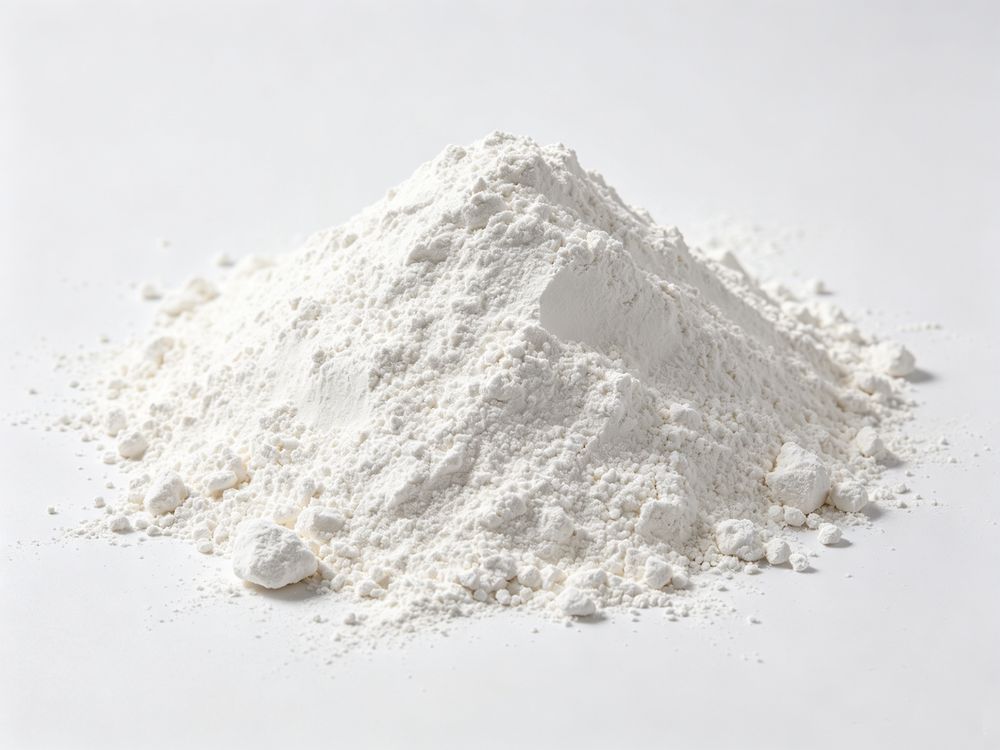
CP-EW is a water-dispersible organoclay produced by inorganic modification of montmorillonite clay. While standard organoclays are rendered hydrophobic (water-repelling) through quaternary ammonium treatment, CP-EW undergoes additional processing to restore dispersibility in aqueous systems. The result is a clay that forms a transparent, thixotropic gel network in water — providing anti-sagging and anti-settling performance in waterborne coatings, personal care, and sealant applications — without requiring organic solvents or polar activators.
Technical Properties
| Parameter | Specification | Test Method |
|---|
| Chemical composition | Inorganic modified montmorillonite clay | — |
| Appearance | Fine powder, white | Visual |
| Moisture content | ≤ 10% | 105°C, 2 hours |
| Fineness | ≥ 95% passing 74 μm (200 mesh) | Sieve analysis |
| Optimal pH range | 7.0–8.0 | — |
| Gel concentration | Forms gel at ≥ 2% in water | — |
Performance Characteristics
- High gelling effectiveness in water — forms thixotropic gel at 2% concentration in deionized or tap water (pH 7.0–8.0)
- Easy direct dispersion — no polar activator, pre-gel, or solvent required; powder added directly to water phase
- Transparent, light-colored gel — suitable for clear waterborne systems and transparent cosmetic formulations without haze
- Anti-settling performance — prevents pigment and filler particle settling in stored waterborne paints and coatings
- High thixotropy and anti-sag — reduces wet film sagging in applied waterborne coatings on vertical surfaces
- Post-correction capability — consistency can be adjusted after initial formulation
Applications and Dosage
| Application | Typical Dosage | Key Function |
|---|
| Waterborne industrial paint | 0.5–1.5 wt% | Anti-settling, anti-sagging, thixotropy |
| Emulsion (latex) paint | 0.3–1.0 wt% | Anti-settling, viscosity stability |
| Putty and filler | 0.5–2.0 wt% | Non-sag consistency, workability |
| Water-borne sealant / adhesive | 0.5–2.0 wt% | Non-sag, extrusion profile |
| Cosmetics (cream, lotion) | 0.5–2.0 wt% | Suspension, texture, thickening |
| Toothpaste / tooth polish | 1.0–3.0 wt% | Thickening, suspension of abrasives |
| Pigment blunge water | 0.2–0.8 wt% | Pigment suspension during grinding |
| Cementing additive | 0.3–1.0 wt% | Fluid loss control, suspension |
Key Difference from Solvent-Based Organoclay: CP-EW is the correct choice for any water-based formulation. Standard organoclay grades (CP-34, CP-APA) are hydrophobic and will not disperse in water — using them in waterborne systems will cause agglomeration, loss of gel performance, and formulation failure. Always specify CP-EW for aqueous systems.
Incorporation Procedure
- Prepare water phase at pH 7.0–8.0 — adjust pH with ammonia or NaOH if needed; acidic or strongly alkaline water reduces gel performance
- Add CP-EW powder directly to the water phase at 0.2–3.0% of total formulation weight
- Disperse at high speed for 20–30 minutes — use a high-shear dissolver or disperser at maximum available speed
- Add additives (biocides, wetting agents, dispersants) after CP-EW is fully hydrated
- Add pigments and fillers and mix thoroughly
- Add emulsion / binder last and mix gently to avoid foam
- Post-correct viscosity if needed by adding additional CP-EW dispersion
Frequently Asked Questions
What is CP-EW water-based organoclay used for?
CP-EW is used as anti-sagging, anti-settling, and thixotropic agent in waterborne industrial and architectural paints, emulsion coatings, putties, toothpaste, cream and lotion formulations, water-borne sealants and adhesives, and blunge water for pigment dispersion. At 0.2–3.0%, it forms a transparent, light-colored gel in water without organic solvents.
Waterborne coatings guide → Does CP-EW require a polar activator?
No. CP-EW disperses directly in water at pH 7.0–8.0 without polar activator or organic solvent. Add the powder directly to the water phase and disperse at high speed for 20–30 minutes. This makes CP-EW easier to incorporate than solvent-based organoclays and suitable for low-VOC, waterborne formulations.
What is the difference between CP-EW and solvent-based organoclay?
Standard solvent-based organoclay (CP-34, CP-APA) is hydrophobic — it will not disperse in water and will agglomerate if added to a waterborne system. CP-EW undergoes additional inorganic modification to restore water dispersibility while maintaining thixotropic gel function for aqueous formulations. Always use CP-EW for water-based systems; use CP-34 or CP-APA for solvent-based systems.
Packaging and Storage
| Parameter | Specification |
|---|
| Standard packaging | 25 kg kraft paper bags with PE inner liner |
| Shelf life | 2 years from manufacture date |
| Storage conditions | Cool, dry warehouse; protect from moisture — CP-EW absorbs water more readily than solvent-based grades |
Related grades: CP-34 (solvent-based equivalent) ·
CP-APA (solvent-based, self-activating) ·
CP-982 (drilling fluid grade)
Related applications: Waterborne Coatings ·
Cosmetics & Personal Care ·
Water-Based Adhesives ·
Water-Based Organoclay Overview