Instant Connect

Scan to connect via WhatsApp or WeChat
Thixotropic organoclay that prevents vertical joint sag, enables clean cartridge dispensing, and suspends heavy fillers throughout shelf life — in polyurethane, epoxy, silicone, MS polymer, polysulfide, and bituminous adhesive and sealant systems.
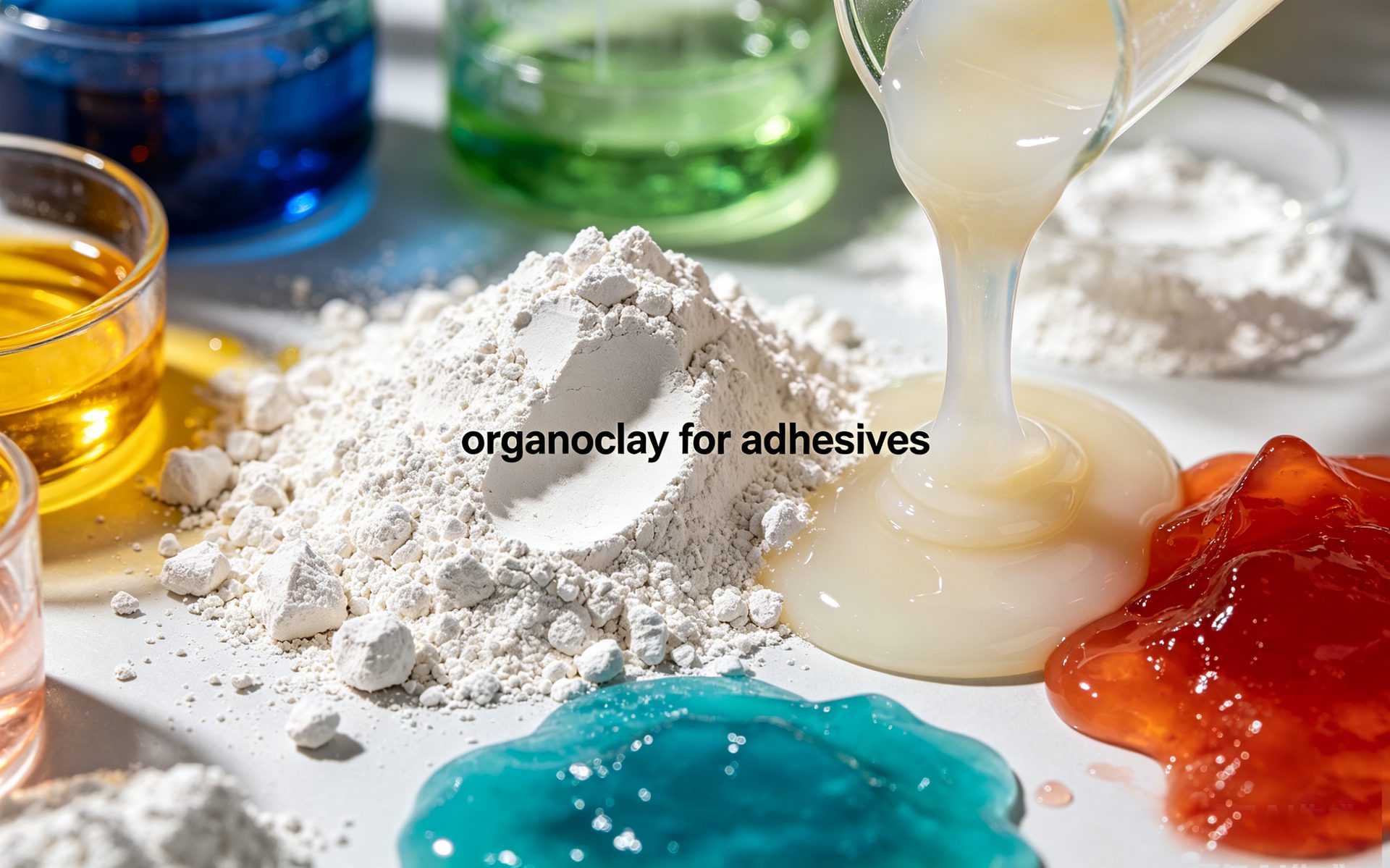
Our adhesive and sealant customers are concentrated in South Korea, Canada, Brazil, Argentina, Colombia, and Russia. The application requirements across these markets share a common thread: non-sag performance on vertical and overhead joints before cure, combined with clean, consistent cartridge dispensing that does not harden or phase-separate during shelf life.
One observation from our field experience: the grade selection logic for adhesives and sealants is closely parallel to lubricating grease formulation. Both require the organoclay to build a stable thixotropic structure in a viscous oil or resin base — and the same grades that work well in grease systems (CP-34, CP-RL, CP-388, CP-250A, CP-31, CP-992) translate directly to construction sealants, automotive adhesives, and industrial bonding systems. If you already use one of these grades in a grease application, the starting point for your sealant formulation is the same grade at a similar treat rate.
| Function | Mechanism | Practical Impact |
|---|---|---|
| Anti-sag | Gel network yield point exceeds gravitational stress on applied bead | Applied bead stays in place on vertical joints, overhead surfaces; passes ASTM C639 slump <3mm |
| Thixotropic dispensing | Gel breaks down under cartridge gun pressure; recovers after dispensing | Easy extrusion even from cold storage; bead holds shape immediately after gun withdrawal |
| Filler suspension | Gel network immobilizes CaCO₃, silica, TiO₂, BaSO₄ at rest | Consistent filler distribution throughout 1–2 year shelf life; no hard-pack in cartridge base |
| Film reinforcement | Clay platelets align in curing polymer matrix | Improved tensile strength, elongation, barrier to moisture and gases; better adhesion at bond line |
| Adhesive / Sealant System | Polarity | Recommended Grade | Dosage |
|---|---|---|---|
| Epoxy adhesives (aromatic amine cure) | Medium–high | CP-APA, CP-MP, CP-34 | 0.5–2.0 wt% |
| Epoxy adhesives (aliphatic amine cure) | Medium | CP-34, CP-APA | 0.5–1.5 wt% |
| Polyurethane sealants (1-part, 2-part) | Medium–high | CP-APA, CP-EDS, CP-MP | 1.0–2.5 wt% |
| Silicone sealants (RTV) | Low–medium | CP-EL, CP-GL, CP-34 | 1.0–2.5 wt% |
| MS polymer / modified silicone | Medium | CP-APA, CP-MP | 1.0–2.0 wt% |
| Polysulfide sealants | Medium | CP-34, CP-APA | 0.5–1.5 wt% |
| Acrylic adhesives (solvent-based) | Medium | CP-10, CP-34 | 0.5–1.5 wt% |
| Construction adhesives | Low–medium | CP-34, CP-40 | 0.5–2.0 wt% |
| Bituminous mastics | Low | CP-34, CP-40 | 1.0–3.0 wt% |
| Unsaturated polyester (UP) putty / body filler | Medium (styrene) | CP-34, CP-40 | 1.0–2.5 wt% |
| Application Requirement | Organoclay Dosage (CP-APA or CP-34) | Target Yield Point |
|---|---|---|
| Light adhesive, moderate thixotropy | 0.5–1.0 wt% | 10–20 Pa |
| Construction sealant, vertical joint | 1.0–2.0 wt% | 20–40 Pa |
| 1-component cartridge, maximum non-sag | 2.0–3.0 wt% | 40–80 Pa |
| ASTM C639 slump <3 mm (standard non-sag test) | 1.0–1.5 wt% typical | ≥20 Pa |
Critical: Never add organoclay to the curing agent (Part B) — amine or anhydride curing agents interfere with activation chemistry and prevent proper gel formation.
Recommended grades for adhesives & sealants: CP-APA (self-activating, ketone/ester systems) · CP-27A (high-polarity epoxy sealants) · CP-VZ (polyurethane & epoxy, ≤20μm) · CP-34 (aromatic systems, with activator)
Related pages: Anti-Sagging Agent · Viscosity Control · Organoclay for Coatings
Tell us your resin system and non-sag requirement — we'll recommend the right grade and ship free samples with TDS and SDS within 48 hours.
We reply within 24 hours on business days.
Thank you! Your inquiry has been received.
We'll get back to you within 24 hours.
WeChat ID
0086-13185071071