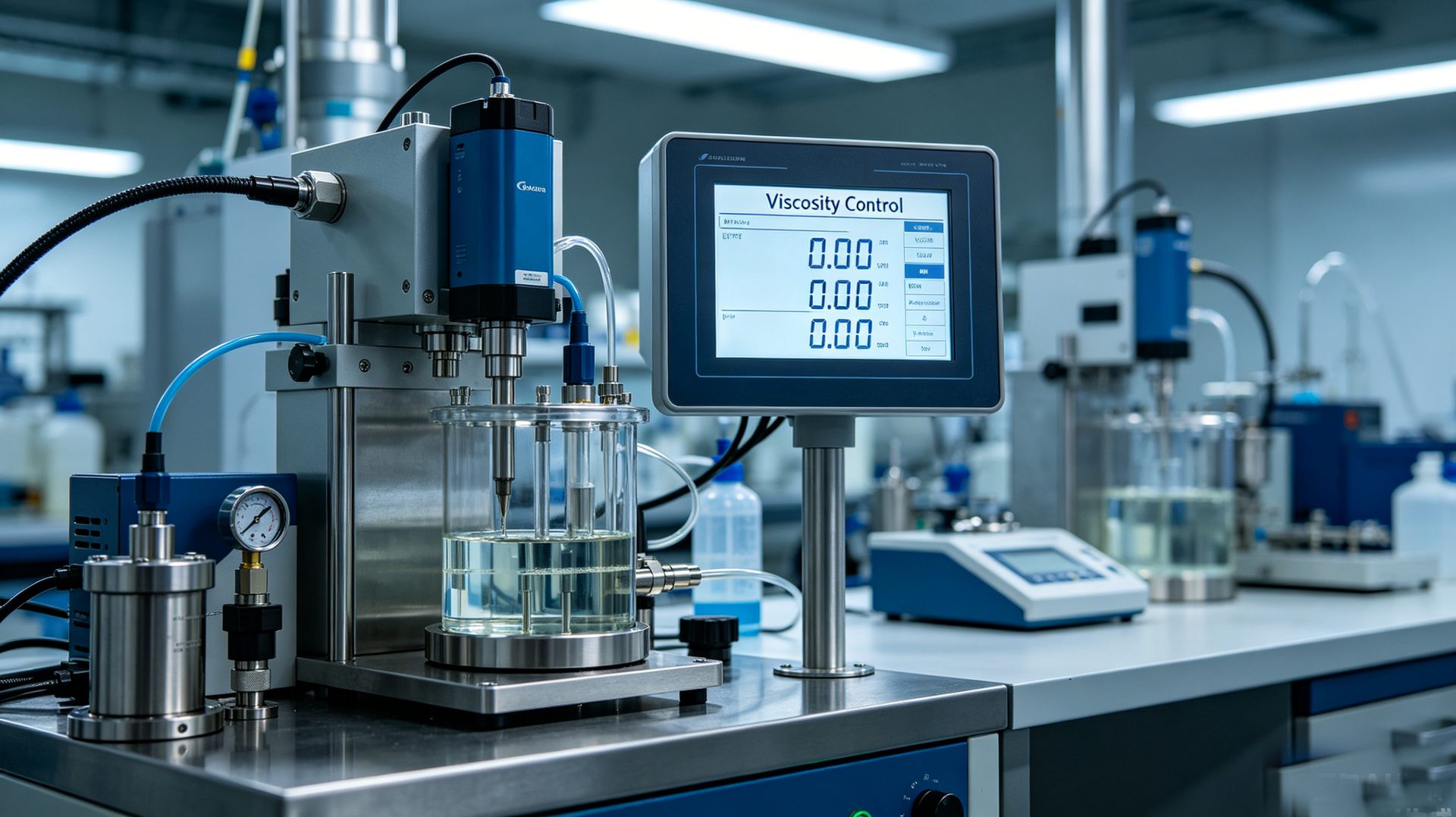
The Dual-Viscosity Problem
Every industrial liquid formulation faces a fundamental conflict: it must be high-viscosity at rest (to prevent settling, dripping, or sagging) and low-viscosity under shear (to allow pumping, spraying, brushing, or extrusion). Conventional viscosity modifiers solve only one side of this problem — organoclay solves both simultaneously through thixotropic gel behavior.
| Condition | Required Behavior | How Organoclay Delivers |
|---|
| Storage at rest | High viscosity → pigments suspended, no settling, no dripping | Intact platelet gel network immobilizes particles; yield point 3–15 Pa prevents settling of all common pigments |
| Under pump / shear | Low viscosity → easy transfer, atomization, application | Network breaks down at shear rate >1 s⁻¹; viscosity drops by 5–15× to allow normal flow |
| Applied film (vertical surface) | Rapid viscosity recovery → no sagging, holds film position | Network rebuilds within 5–30 seconds; film holds without sliding before cure begins |
| Under drilling pump pressure | Low enough ECD → no lost circulation; adequate cutting transport | High yield point at low shear moves cuttings; ECD manageable under pump pressure |
What is Thixotropy?
Thixotropy is a time-dependent, reversible decrease in viscosity under shear. A thixotropic material has high viscosity at rest, lower viscosity under sustained shear, and recovers its high viscosity after shear is removed — with recovery taking seconds to minutes. Thixotropic index (TI) = viscosity at 6 rpm ÷ viscosity at 60 rpm (Brookfield). Organoclay-based systems achieve TI of 3.0–8.0 in solvent-based formulations.
Organoclay Viscosity Control Mechanism
Organoclay platelets (1 nm thick, 200–500 nm wide) form a three-dimensional "house-of-cards" network in organic solvent and oil systems through edge-to-face electrostatic interactions:
- At rest: Platelet edges (positive charge) interact with platelet faces (negative charge) → interconnected 3D network → high yield point → particles suspended, film held in place
- Under shear (application): Shear energy overcomes edge-face bonds → network collapses → viscosity drops 5–15× → easy flow, good leveling
- Shear removed (film applied): Edge-face interactions reform → network rebuilds in 5–30 seconds → prevents sag → film stays in place
This behavior is thermally stable — organoclay maintains its thixotropic profile from below 0°C to above 150°C (some degradation above ~180°C in sustained exposure), significantly outperforming wax-based and polymer viscosity modifiers at elevated temperatures.
Viscosity Control by Application
| Application | Viscosity Challenge | Target TI / Rheology Parameter | Recommended Grade | Dosage |
|---|
| Solvent-Based Coatings | Pigment settling, sag on vertical surfaces, spray atomization | TI ≥ 4.0 (standard); TI 5–8 (thick-film, marine) | CP-34, CP-40, CP-180B, CP-APA | 0.2–1.5 wt% |
| Oil-Based Drilling Fluids | Cutting transport, barite sag in deviated wells, ECD management | YP 10–25 Pa; 10-min gel 8–25 Pa; YP/PV >1.0 | CP-34, CP-40, CP-EL, CP-GL | 5–20 kg/m³ |
| Lubricating Greases | Thickener consistency, NLGI grade, thermal stability | NLGI 1–3 consistency; stable to 180°C | CP-250A | 8–15 wt% on base oil |
| Adhesives & Sealants | Non-sag extrusion profile, open time, surface stand | TI ≥ 3.5; non-flow at 0.1 s⁻¹ shear | CP-APA, CP-EDS, CP-34 | 0.5–2.0 wt% |
| Printing Inks | Anti-misting, ink transfer, tack profile | TI 2–4 (depends on press type) | CP-34, CP-MP, CP-10 | 0.5–2.0 wt% |
Thixotropic Index Target Guide
| Coating Type | Target TI (6/60 rpm) | Organoclay Dosage (CP-34 in xylene) |
|---|
| Clear lacquers, wood finishes | 2.5–3.5 | 0.2–0.4 wt% |
| Architectural paints (interior/exterior) | 3.5–4.5 | 0.3–0.6 wt% |
| Industrial protective coatings | 4.0–5.5 | 0.5–1.0 wt% |
| Marine coatings, antifouling | 5.0–7.0 | 0.8–1.5 wt% |
| Thick-film anti-corrosion primers | 6.0–8.0 | 1.0–2.0 wt% |
Key Takeaway: To achieve thixotropic index ≥ 4.0 in a standard xylene-alkyd system, CP-34 at 0.5 wt% with ethanol activator at 30% of organoclay weight, mixed at 2,000 rpm for 20 minutes, delivers TI of 4.5–5.5 consistently based on our internal application testing across 200+ formulations.
Comparing Thixotropic Agents in Coatings
| Additive | Max TI Achievable | Anti-Settling | Anti-Sagging | Thermal Stability | Transparency |
|---|
| Organoclay | 6–8 | Excellent | Excellent | Excellent (to 180°C) | Good–Excellent (fine grades) |
| Fumed silica | 4–6 | Good | Good | Good | Poor (hazy) |
| Polyamide wax | 3–5 | Good | Moderate | Poor (melts <85°C) | Poor |
| Castor oil derivatives | 2–4 | Moderate | Moderate | Poor | Poor |
| HEUR (water-based) | 2–3 | Moderate | Moderate | Good | Good |
Frequently Asked Questions
What are thixotropic agents?
Thixotropic agents are rheology additives that build a structured viscosity network at rest and reduce viscosity reversibly under shear. In solvent-based industrial formulations, organoclay is the most widely used thixotropic agent — it forms a platelet gel network that suspends pigments and prevents sagging at rest, then collapses under application shear to allow easy brushing, rolling, or spraying.
What is a thixotropic agent? → What is the purpose of a thixotropic agent?
A thixotropic agent serves three simultaneous functions: (1) anti-settling — suspends dense particles at rest; (2) anti-sagging — prevents wet film from running on vertical surfaces; (3) application ease — low viscosity under shear allows pumping, spraying, and leveling. Organoclay achieves all three at 0.2–2.0 wt% in solvent-based formulations — no other single additive class provides this combination at equivalent dosage and cost.
What does thixotropic mean?
Thixotropic means a material becomes less viscous when sheared and gradually recovers high viscosity when shear stops — a reversible, time-dependent process. Thixotropic index (TI = viscosity at 6 rpm ÷ viscosity at 60 rpm) quantifies this behavior. Organoclay-based formulations in coatings typically achieve TI of 3.0–8.0 depending on grade and dosage.
How does organoclay control viscosity?
Organoclay forms a three-dimensional platelet gel network through edge-to-face electrostatic interactions between exfoliated clay platelets. At rest, the intact network provides high yield point and high low-shear viscosity. Under application shear, the network breaks down — viscosity drops. After shear, the network rebuilds in 5–30 seconds. This mechanism works equally in coating storage (anti-settling), on applied films (anti-sagging), and in drilling fluids (cuttings suspension).
Detailed mechanism → How do I measure thixotropic index in coatings?
Use a Brookfield rotational viscometer: TI = viscosity at 6 rpm ÷ viscosity at 60 rpm, measured at 25°C with the same spindle. Target: TI ≥ 3.5 for light-pigment architectural coatings; TI ≥ 4.0 for industrial protective coatings; TI 5–8 for thick-film marine or anti-corrosion coatings. If TI is below target, increase organoclay by 10–15% and re-mix for 5 minutes before re-measuring.
What is the difference between thixotropy and pseudoplasticity?
Pseudoplasticity is immediate shear-thinning (no time lag) — viscosity drops as shear rate increases and recovers instantly when shear stops. Thixotropy is time-dependent — viscosity decreases gradually under shear and recovers gradually after shear stops. Organoclay provides both behaviors: pseudoplastic (viscosity drops rapidly under shear) and thixotropic (full gel structure rebuilds over 5–30 seconds). Both properties together enable anti-settling, anti-sagging, and good application behavior.
Which organoclay grade provides the best viscosity control in coatings?
For maximum gel strength in aromatic solvents (xylene, toluene): CP-34 or CP-40 with polar activator. For self-activating (no activator needed): CP-180B or CP-APA. For widest polarity range (ketone/ester/aromatic): CP-388, CP-MPS, or CP-MP10. For transparent coatings (≤10 μm fineness): CP-MP or CP-MPS. Contact our technical team with your solvent system and target TI for a specific recommendation.
Related pages: Anti-Settling Agent Guide ·
Organoclay for Paint & Coatings ·
What is a Thixotropic Agent? ·
What is a Rheology Modifier? ·
Organoclay vs Fumed Silica