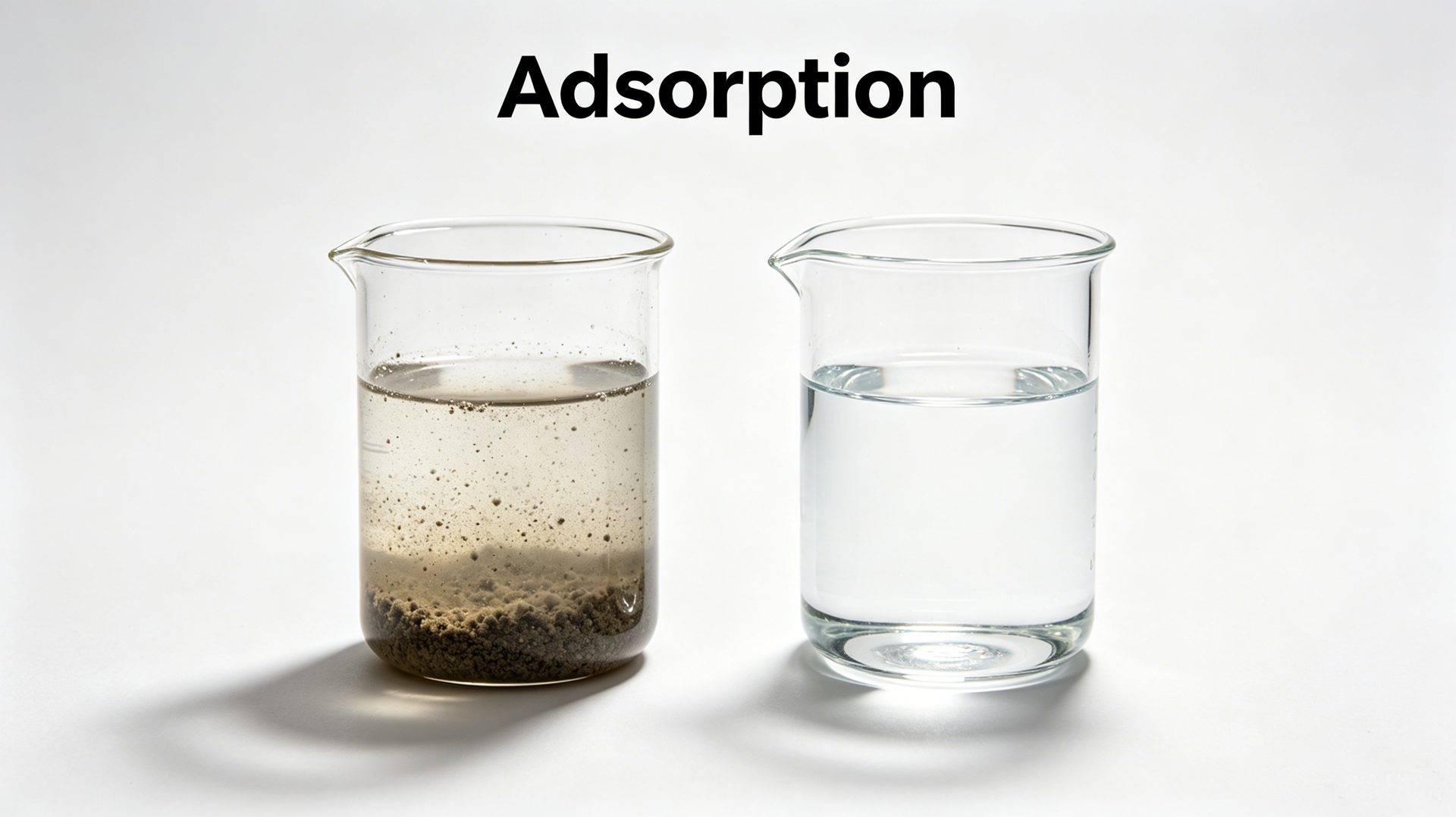
What is Organoclay Adsorption?
Organoclay adsorption is the removal of hydrophobic organic contaminants and certain heavy metals from water or soil through their partitioning into the organophilic surface of modified clay. Natural bentonite clay has a hydrophilic (water-attracting) surface that repels non-polar organic molecules. Organoclay, modified with quaternary ammonium compounds, reverses this — creating an organophilic interlayer environment that strongly attracts non-polar contaminants. Organic pollutants preferentially partition from the aqueous phase into the organoclay organic phase, achieving removal efficiencies of 80–99% for petroleum hydrocarbons, chlorinated solvents, PAHs, and PCBs at practical dosage rates.
Adsorption Mechanism
Organoclay removes contaminants through two primary mechanisms:
- Hydrophobic partitioning (primary mechanism for organic pollutants): Non-polar organic molecules preferentially leave the aqueous phase and partition into the organic-like interlayer environment created by the quaternary ammonium modifier. This is thermodynamically favored — organic molecules are more compatible with the organic clay surface than with water. Partition coefficients (Koc) for organoclay are 10–100× higher than for natural clay or activated carbon for many hydrophobic organic compounds.
- Surface ion exchange and complexation (for heavy metals): Modified clay surfaces retain some cation exchange capacity that allows removal of heavy metal cations, particularly when present as organo-metal complexes. Most effective for lead (Pb²⁺), cadmium (Cd²⁺), and chromium (Cr³⁺) at circumneutral pH.
Contaminants Removed by Organoclay
| Contaminant Class | Examples | Typical Removal | Effective Dosage |
| Petroleum hydrocarbons (TPH) | Crude oil, diesel, mineral oil, fuel oil | 85–99% | 1–5 g/L |
| BTEX | Benzene, toluene, ethylbenzene, xylene | 80–98% | 0.5–3 g/L |
| Polycyclic aromatic hydrocarbons (PAHs) | Naphthalene, pyrene, anthracene, benzo[a]pyrene | 90–99% | 1–5 g/L |
| Chlorinated solvents | TCE, PCE, chlorobenzene, dichloromethane | 75–95% | 2–6 g/L |
| PCBs | Aroclor mixtures, biphenyl derivatives | 85–99% | 2–8 g/L |
| Pesticides / herbicides | Atrazine, lindane, chlorpyrifos | 70–95% | 1–5 g/L |
| Heavy metals | Pb²⁺, Cd²⁺, Cr³⁺ | 60–90% | 3–10 g/L |
| VOCs | Toluene, MEK, acetone (at higher concentrations) | 50–85% | 2–8 g/L |
Key Advantage Over Activated Carbon: Organoclay outperforms granular activated carbon (GAC) for petroleum hydrocarbons and high-molecular-weight PAHs because the partitioning mechanism handles continuous-phase oil and emulsified hydrocarbons that would simply coat and block activated carbon pores. Organoclay also does not require regeneration for single-use environmental remediation applications.
Industrial Applications
1. Industrial Wastewater Treatment
Organoclay is effective as a polishing step after primary oil-water separation in refinery, petrochemical, and metalworking wastewater treatment. At 1–3 g/L dosage, organoclay reduces dissolved and emulsified petroleum hydrocarbons to below discharge limits (<10 mg/L TPH) from initial concentrations of 100–500 mg/L.
2. Produced Water Treatment (Oil & Gas)
Produced water from oil and gas extraction contains dissolved aromatics (BTEX), residual oil, and naturally occurring radioactive materials (NORM). Organoclay at 2–5 g/L removes dissolved organic components before injection into disposal wells or discharge, meeting regulatory limits for offshore and onshore produced water management.
3. Groundwater Remediation — Permeable Reactive Barriers
Organoclay mixed with sand (10–30 wt% organoclay) is installed as permeable reactive barrier (PRB) fill in trenches intercepting contaminated groundwater plumes. Effective for BTEX, chlorinated solvents, and PAH plumes — flow-through barriers provide passive in-situ treatment without pumping.
4. Contaminated Soil Treatment
Organoclay mixed into contaminated soil (5–15 wt%) immobilizes organic pollutants — reducing leachability (TCLP), bioavailability, and risk without requiring excavation. Applicable to petroleum-contaminated soil, PCB-contaminated sites, and pesticide-impacted agricultural land.
Dosage Guide by Application
| Application | Initial Contaminant Level | Organoclay Dosage | Expected Effluent Quality |
| Refinery wastewater (TPH) | 100–500 mg/L | 1–5 g/L | <15 mg/L TPH |
| BTEX in groundwater | 1–50 mg/L | 0.5–3 g/L | <0.5 mg/L BTEX |
| Chlorinated solvents (TCE) | 1–20 mg/L | 2–6 g/L | <0.5 mg/L TCE |
| PAHs in stormwater | 0.1–5 mg/L | 0.5–2 g/L | <0.05 mg/L PAH |
| Produced water (dissolved organics) | 50–200 mg/L | 2–5 g/L | <20 mg/L organics |
| Heavy metals (Pb, Cd) | 1–50 mg/L | 3–10 g/L | <0.5 mg/L |
Frequently Asked Questions
What does organoclay adsorb?
Organoclay adsorbs hydrophobic organic compounds including petroleum hydrocarbons (BTEX, TPH, PAHs), chlorinated solvents (TCE, PCE), PCBs, pesticides, and certain heavy metals (Pb²⁺, Cd²⁺, Cr³⁺). The organophilic surface created by quaternary ammonium modification attracts non-polar organic molecules through hydrophobic partitioning — organic contaminants preferentially migrate from water into the organoclay organic phase. Removal efficiencies of 80–99% are typical for petroleum hydrocarbons and PAHs at 1–5 g/L dosage.
How does organoclay remove contaminants from water?
Organoclay removes organic contaminants through hydrophobic partitioning — non-polar organic molecules preferentially leave the aqueous phase and partition into the organophilic interlayer environment of the modified clay. This is thermodynamically driven: organic molecules are far more compatible with the organic clay surface than with water. Organoclay partition coefficients (Koc) are 10–100× higher than natural clay for petroleum hydrocarbons and chlorinated solvents, making it significantly more effective per unit mass.
What is organoclay used for in water treatment?
Organoclay is used in water treatment for: industrial wastewater polishing (refineries, petrochemical, metalworking); produced water treatment in oil and gas operations; groundwater remediation via permeable reactive barriers; stormwater treatment for petroleum and PAH removal; and as a soil amendment for contaminated site stabilization. Each application leverages organoclay's capacity to remove dissolved and emulsified organic contaminants that resist conventional treatment.
Full water treatment application guide → How much organoclay is needed to treat contaminated water?
Dosage depends on contaminant type and concentration: petroleum hydrocarbons at 100–500 mg/L → 1–5 g/L organoclay; BTEX at 1–50 mg/L → 0.5–3 g/L; chlorinated solvents → 2–6 g/L; heavy metals → 3–10 g/L. Batch jar testing with actual site water is recommended before scale-up — contact our technical team for testing protocol and free 500g samples for bench evaluation.
Can organoclay be used for soil remediation?
Yes. Organoclay at 5–15 wt% mixed into contaminated soil immobilizes organic pollutants — reducing TCLP leachability, bioavailability, and ecological risk without excavation. It is used for in-situ stabilization of petroleum-contaminated sites, PCB-contaminated soil, and as fill in permeable reactive barriers intercepting contaminated groundwater plumes. The organoclay binds contaminants in the soil matrix, preventing migration to groundwater.
Related pages: Organoclay for Water Treatment ·
Anti-Settling Agent ·
What is Organoclay? ·
What is Bentonite? ·
Water-Based Organoclay