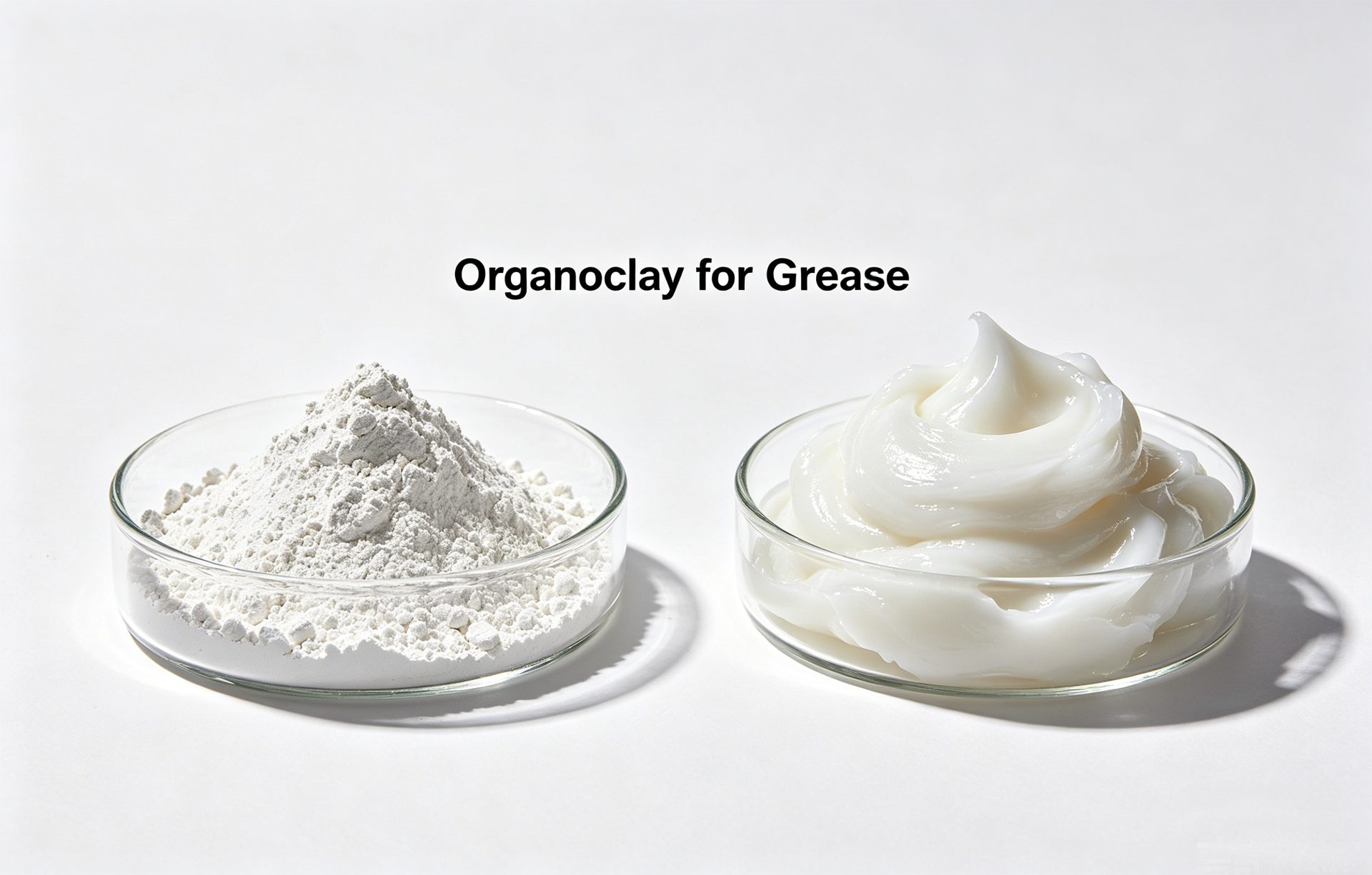
Why Organoclay for Grease?
Organoclay grease thickener: An organophilic modified montmorillonite clay that forms a platelet gel matrix holding base oil in suspension. Unlike soap thickeners, clay minerals do not melt — organoclay greases have no measurable drop point (mineral decomposition above ~600°C), maintaining consistent structure at all practical application temperatures, including continuous service above 200°C.
Grease Thickener Comparison
| Thickener Type | Drop Point | Max Continuous Service | Water Resistance | Best Use Case |
|---|
| Organoclay (clay grease) | None (>260°C) | >200°C continuous | Excellent | Furnace chains, kilns, extreme heat |
| Lithium complex | ~260°C | ~180°C | Good | High-temp industrial (intermittent) |
| Polyurea | ~265°C | ~180°C | Excellent | Electric motor bearings |
| Lithium soap | ~190°C | ~120°C | Good | General purpose multipurpose |
| Calcium soap | ~100°C | ~70°C | Excellent | Wet/marine, low-temperature |
Key Takeaway — The No-Drop-Point Advantage: Most soap-based thickeners melt at their drop point, causing catastrophic lubrication failure at temperature. Organoclay clay mineral platelets are inorganic — they decompose above 600°C, far beyond any lubrication application. Organoclay greases maintain full consistency at 250°C+ indefinitely, which no soap grease can match.
Our Recommended Grades for Lubricating Grease
Based on 20+ years of grease formulation support, our most frequently recommended grades are: CP-34, CP-RL, CP-388, CP-250A, CP-31, and CP-992. Here is how we select between them:
- Synthetic or mineral oil base (PAO, Group I/II/IV): CP-388, CP-250A, CP-31, CP-992 — these provide the best rheological structure in conventional and synthetic base oils.
- Vegetable oil base: CP-34 and CP-RL — these two deliver the best combination of quality and price-competitiveness in vegetable oil systems, and are our consistent recommendation when customers want to balance performance and cost.
- High-temperature applications (bearing grease for kilns, furnace conveyors, oven chains): CP-250A and CP-31 — both have confirmed high-temperature stability and are the grades we specify for applications where soap-based thickeners fail at temperature.
Compared to other Chinese organoclay suppliers, what customers consistently come back for is: stable quality batch to batch, a wide grade range so the right grade is always available for their exact system, and competitive pricing that reflects our manufacturing efficiency rather than a premium for brand recognition.
Grade Selection by Base Oil
| Base Oil Type | API Group | Polarity | Recommended Grade | Dosage for NLGI 2 |
|---|
| Mineral oil (paraffinic) | Group I | Low | CP-EL, CP-GL, CP-34 | 6–10 wt% |
| Mineral oil (naphthenic) | Group II | Low | CP-EL, CP-GL, CP-34 | 6–10 wt% |
| Polyalphaolefin (PAO) | Group IV | Low–medium | CP-EL, CP-GL, CP-388 | 8–12 wt% |
| Ester oils | Group V | Medium–high | CP-EDS, CP-MP, CP-388 | 8–12 wt% |
| White oils | Group II+ | Low | CP-EL, CP-GL | 6–10 wt% |
| Vegetable oils (bio-lubricant) | — | Medium | CP-34, CP-RL | 8–12 wt% |
| High-temperature synthetic | Group IV/V | Low–medium | CP-250A, CP-31 | 8–13 wt% |
NLGI Consistency vs Dosage
| NLGI Grade | Penetration (0.1 mm) | Organoclay Dosage (CP-EL, mineral oil) | Typical Application |
|---|
| NLGI 1 | 310–340 | 4–7 wt% | Centralized lubrication systems; low-temperature |
| NLGI 2 | 265–295 | 6–10 wt% | General purpose bearings — most common grade |
| NLGI 3 | 220–250 | 9–13 wt% | Wheel bearings, high-speed, vertical shafts |
Manufacturing Process: Two Methods
Organoclay grease manufacturing requires no saponification step — simpler than soap-based grease production. A colloid mill or homogenizer is essential for full platelet delamination in either method below.
Method A: Direct Addition (Full-Batch)
The organoclay is dispersed directly in the full base oil charge. This is the standard approach for batch sizes where the kettle's agitator can deliver adequate shear across the whole volume.
- Heat base oil to 60–70°C in the grease kettle
- Add organoclay powder (7–10 wt% of total formulation) slowly under agitation — wet all particles
- Add polar activator (30–40% of organoclay weight) — options: 95% ethanol, propylene carbonate, acetone, or dipropyl carbonate
- High-shear mix for 25–30 minutes using Cowles dissolver or high-shear mixer
- Pass through colloid mill 2–3 times — this is the critical step; full platelet delamination requires colloid milling, not just batch mixing
- Cool under controlled agitation to below 60°C
- Add performance additives (EP agents, antioxidants, corrosion inhibitors) — add after organoclay activation to avoid interference
- Filter and package
Method B: Pre-Gel / Staged Addition (Two-Stage Heating)
The organoclay is first built into a concentrated gel paste in only part of the base oil, then blended into the remainder. This staged approach is useful for larger batches, kettles where full-volume high shear is limited, or when more consistent gel formation needs to be confirmed before scale-up.
- Take 1/3 to 1/2 of the total base oil and heat it separately to ~60°C
- Add the full organoclay charge (7–10 wt% of total formulation) and polar activator (30–40% of organoclay weight) to this portion
- High-shear mix until a concentrated, uniform clay-gel paste forms
- Separately heat the remaining base oil to 60–80°C
- Blend the gel paste into the remaining heated base oil under agitation until uniform
- Pass the combined batch through colloid mill 2–3 times
- Cool, add performance additives, filter, and package — same as Method A
| Aspect | Method A: Direct Addition | Method B: Pre-Gel / Staged Addition |
|---|
| Process | Organoclay dispersed directly in the full base oil charge | Organoclay pre-gelled in a portion of base oil, then blended into the remainder |
| Equipment | Kettle sized for full batch + colloid mill | Smaller pre-gel vessel + main kettle + colloid mill |
| Temperature | 60–70°C throughout | Pre-gel portion ~60°C; remaining oil 60–80°C before blending |
| Best for | Standard batch sizes with adequate full-volume agitation | Larger batches, or kettles where full-volume high shear is limited |
Polar Activator Guide
| Activator | Dosage (% of OC weight) | Notes |
|---|
| 95% Ethanol | 30–40% | Common, moderate evaporation rate |
| 95% Methanol | 30–40% | Good activation; higher evaporation rate |
| Acetone | 30–50% | Highly effective; very high evaporation — use in ventilated kettle |
| Propylene carbonate | 25–35% | Low volatility; stays in grease — preferred for final product use |
| Dipropyl carbonate | 25–35% | Low volatility; preferred for food-grade grease applications |
Caution: Too little activator = weak, unstable consistency. Too much activator = disrupted gel network ("activator poisoning") → soft, inconsistent grease. Titrate incrementally to find the optimal dose for each base oil / grade combination.
Key Performance Properties
| Property | Organoclay Grease Performance | Test Method |
|---|
| Drop point | None (>260°C — clay does not melt) | ASTM D566 / ASTM D2265 |
| Max continuous service temperature | >200°C | Application testing |
| Water washout resistance | <5% weight loss at 79°C | ASTM D1264 |
| Oxidation stability | <3 psi pressure drop at 100h, 99°C | ASTM D942 |
| NLGI grades achievable | 000 to 3 (typical: 1, 2, 3) | ASTM D217 penetration |
| Operating temperature range | -30°C to >200°C | — |
Frequently Asked Questions
What is organoclay used for in lubricating grease?
Organoclay is used as the thickener in clay-based (bentone-type) lubricating greases. It forms the structural matrix that holds base oil in suspension at NLGI 1–3 consistency. Unlike soap thickeners, organoclay greases have no drop point — they maintain full consistency above 260°C indefinitely, making them the standard for furnace conveyor chains, kiln bearings, steel mill equipment, and any application where continuous high-temperature service is required.
What is the drop point of organoclay grease?
Organoclay greases have no measurable drop point. The clay mineral platelet structure is inorganic — it decomposes above ~600°C, far beyond any practical lubrication application. This contrasts with lithium soap (drop point ~190°C), lithium complex (~260°C), and polyurea (~265°C). For continuous service above 180°C — especially furnace chains, oven conveyors, and kiln equipment — organoclay clay grease is the only thickener type that reliably prevents lubrication failure.
How much organoclay do I need in lubricating grease?
For mineral oil (Group I/II): NLGI 2 requires 6–10 wt% organoclay on base oil weight; NLGI 3 requires 9–13 wt%. For PAO (Group IV): 8–12 wt% for NLGI 2. Plus polar activator at 30–40% of organoclay weight (propylene carbonate or ethanol). Titrate to find the specific optimal dose for your base oil — the minimum penetration point corresponds to the optimal activator level.
What grease thickener is best for high temperature?
For continuous high-temperature service above 180°C: organoclay clay grease is the preferred choice — no drop point, full consistency maintained above 260°C. For intermittent high-temperature exposure up to ~180°C: lithium complex or polyurea are sufficient and more economical. For applications above 200°C continuous (furnace chains, kiln bearings, oven conveyors): only organoclay clay grease provides reliable performance.
Which organoclay grade is best for lubricating grease?
For mineral oil and PAO base: CP-EL or CP-GL (most widely used grease grades — consistent NLGI 2 at 7–9 wt% in Group I/II mineral oil). For ester-based and high-polarity synthetic oils: CP-EDS (fine particle ≤10 μm, broader polarity range). For wide-range base oil compatibility: CP-34 or CP-40. Contact our technical team with your base oil specification and target NLGI grade for a specific recommendation and free sample.
What is the difference between clay grease and lithium grease?
Clay grease (organoclay-thickened): no drop point, >260°C service, excellent water washout resistance (ASTM D1264 <5%), wide -30°C to >200°C operating range — ideal for extreme temperature and moisture exposure. Lithium grease: drop point ~190°C, max continuous service ~120°C, good water resistance — suitable for general industrial, automotive, and moderate-temperature applications. Clay greases are typically more expensive but provide performance that lithium greases cannot match at high temperatures.
How is organoclay grease manufactured?
No saponification is required. Process: heat base oil to 60–70°C → add organoclay (7–10 wt%) under agitation → add polar activator (30–40% of organoclay weight) → high-shear mix 25–30 minutes → pass through colloid mill 2–3 times (this is the critical step — colloid milling achieves full platelet delamination and consistent NLGI grade) → cool → add performance additives → filter and package. Skipping the colloid mill step results in inconsistent penetration and poor performance.
Are there different methods for manufacturing organoclay grease?
Yes — two common approaches. Method A (Direct Addition): organoclay and activator are dispersed directly in the full base oil charge at 60–70°C, then colloid milled. Method B (Pre-Gel / Staged Addition): the organoclay charge is first built into a concentrated gel paste in 1/3 to 1/2 of the base oil at ~60°C, while the remaining oil is separately heated to 60–80°C; the paste is then blended into the remaining oil before colloid milling. Method B suits larger batches or kettles with limited full-volume shear, since the gel paste quality can be confirmed before scale-up. Both methods finish with the same colloid milling and packaging steps.
Recommended grades for lubricating grease: CP-250A (synthetic & vegetable oil, drop point >260°C) ·
CP-720A (vegetable oil, biodegradable EAL grease) ·
CP-2143 (naphthenic & paraffin mineral oil) ·
CP-2148 (zero impurities, precision bearings) ·
CP-21A (high purity, mineral oil base)
Related pages: High-Temperature Grease Guide ·
High Temperature Stability ·
What is a Gelling Agent? ·
Certifications & Quality