Instant Connect

Scan to connect via WhatsApp or WeChat
Organophilic clay rheology modifier that prevents pigment settling, controls sag on vertical surfaces, and provides thixotropic application behavior in solvent-based, high-solid, and oil-based industrial coatings.
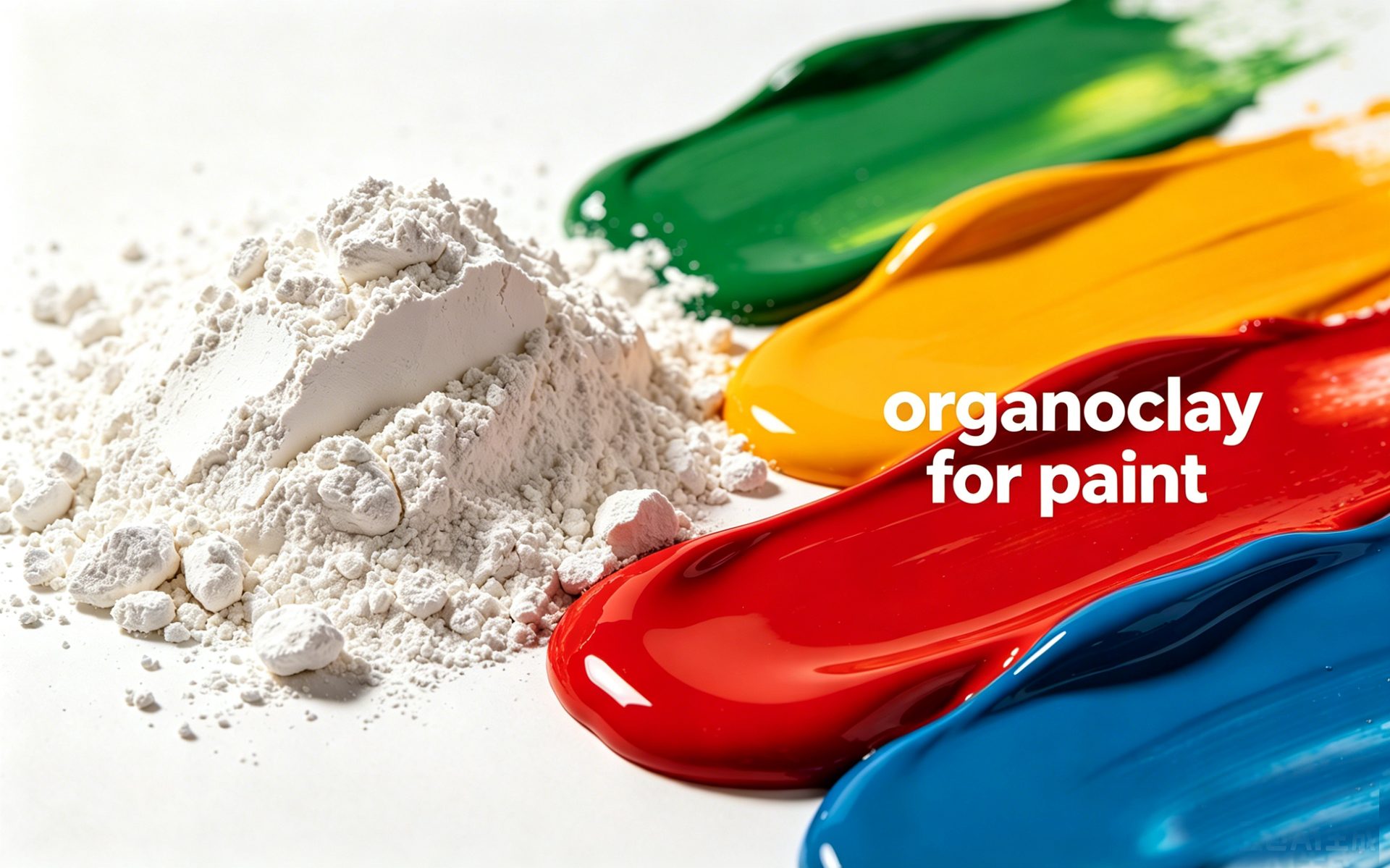
We have supplied organoclay to the paint and coatings industry for over 20 years. In that time, the two problems we hear from customers every time are the same: pigment settling during storage (paint separates in the can; pigments form a hard cake at the bottom), and sagging on vertical surfaces during application. Both are solvable — completely — with the right organoclay at the right dosage. If these problems persist after using organoclay, the issue is almost always grade selection, dosage, or dispersion method — not the additive itself. Our technical team troubleshoots these cases daily.
What sets our approach apart: we don't simply recommend a standard grade. We look at your specific solvent system, your formulation cost target, and your production equipment, and we give you the grade that solves your problem at the best price point. The goal is a long-term stable supply relationship — not a one-time sale.
Solvent-based industrial coatings face three persistent formulation problems. Organoclay solves all three simultaneously — in a single additive at treat rates of 0.2–2.0 wt%:
| Problem | Root Cause | Organoclay Solution |
|---|---|---|
| Pigment settling during storage | Dense pigments (TiO₂, barium sulfate, red iron oxide) sink through low-viscosity medium at rest | Thixotropic gel network immobilizes pigments at rest → no hard cake; easily re-dispersible soft sediment |
| Sagging of wet film on vertical surfaces | Gravity pulls the wet film downward before cure begins | Gel network rebuilds within seconds of application shear stopping → film holds in place at all film builds |
| Poor application behavior (too thick to spray or brush) | High-viscosity network present during application | Network breaks down instantly under application shear → low viscosity during spraying, rolling, or brushing → levels smoothly |
When organoclay powder is dispersed under high shear in a solvent or resin system, individual clay platelets (1 nm thick, 200–500 nm wide) exfoliate from stacked aggregates and self-organize through edge-to-face electrostatic interactions into a three-dimensional "house-of-cards" gel network that provides thixotropy:
Beyond rheology, organoclay platelets align in the drying film — creating a tortuous path for moisture and corrosive ions that measurably improves corrosion barrier performance in epoxy and polyurethane primers. In our testing across 50+ anti-corrosion coating formulations, adding 0.5 wt% CP-34 reduced moisture vapor transmission rate by 18–24% compared to the control formulation without organoclay.
| Coating Type | Key Requirement | Recommended Grade | Treat Rate |
|---|---|---|---|
| Industrial protective coatings (epoxy, PU, alkyd) | Heavy pigment anti-settling, anti-sagging, barrier reinforcement | CP-34, CP-40, CP-388 | 0.3–1.5 wt% |
| Marine coatings (antifouling, hull, coal tar epoxy) | Extreme sag resistance, stability in aggressive solvent systems | CP-34, CP-40, CP-EL | 0.5–2.0 wt% |
| Architectural coatings (exterior, interior alkyd) | Anti-settling, good brushability, light color | CP-10, CP-10A, CP-26, CP-100 | 0.2–0.8 wt% |
| Transparent coatings, clear lacquers | Clear gel (≤10 μm fineness), no haze | CP-MP, CP-MPS, CP-EDS, CP-EZ10 | 0.2–1.0 wt% |
| Wood & furniture coatings | Anti-sagging on vertical panels, leveling, transparency | CP-EZ10, CP-180B, CP-MP | 0.2–1.5 wt% |
| Anti-corrosion primers (zinc-rich, phosphate) | Dense pigment suspension, barrier reinforcement | CP-34, CP-APA, CP-EZ10 | 0.3–1.5 wt% |
| Road marking & traffic paint | High sag resistance at thick film build, temperature stability | CP-34, CP-40 | 0.5–1.5 wt% |
| High-solid coatings (>80% NV) | Anti-sagging without activator, simple processing | CP-180B, CP-APA (self-activating) | 0.5–2.0 wt% |
Organoclay grade selection also depends on the polarity of your solvent system. Match your solvent to the grade using Kauri-Butanol (KB) value:
| Solvent System | KB Value | Dispersing Type | CP Grade |
|---|---|---|---|
| Aliphatic / mineral spirits / naphtha | <40 | Conventional (with activator) | CP-EL, CP-GL, CP-24B |
| Xylene / toluene / aromatic blends | 40–65 | Conventional or self-activating | CP-34, CP-40, CP-10, CP-180B |
| Ketones / esters / ether esters (MEK, butyl acetate) | 65–85 | Self-activating (no activator needed) | CP-APA, CP-MP, CP-EDS |
| Wide / mixed / unknown polarity | Any | Wide-range easy-dispersing | CP-388, CP-MPS, CP-MPZ, CP-MP10 |
| Grade | LOI (1000°C) | Moisture | Dispersion Fineness | Polarity Range | Dispersing Type |
|---|---|---|---|---|---|
| CP-10 | 30–34% | ≤3.5% | ≤40 μm | Non-polar to medium | Easy-dispersing |
| CP-10A | 30–34% | ≤3.5% | ≤40 μm | Non-polar to medium | Easy-dispersing |
| CP-26 | 26–29% | ≤3.5% | ≤40 μm | Non-polar to medium | Easy-dispersing (economical) |
| CP-100 | 26–29% | ≤3.5% | ≤40 μm | Non-polar to medium | Easy-dispersing (economical) |
| CP-34 | 28–30% | ≤3.5% | Standard | Low to medium-high | Conventional |
| CP-40 | 28–30% | ≤3.5% | Standard | Low to medium-high | Conventional |
| CP-180B | 29–32% | ≤3.5% | Standard | Intermediate to low | Conventional / self-activating |
| CP-388 | 31–34% | ≤3.5% | Standard | Non-polar to high | Easy-dispersing |
| CP-APA | 32–35% | ≤3.5% | Standard | Moderate to high | Self-activating |
| CP-MP | 34–36% | ≤3.5% | ≤10 μm | Low to high | Easy-dispersing (high clarity) |
| CP-MPS | 31–34% | ≤3.5% | ≤10 μm | Non-polar to high | Easy-dispersing (high clarity) |
| CP-EDS | 34–37% | ≤3.5% | ≤10 μm | Medium to high | Easy-dispersing (high clarity) |
| CP-EZ10 | 32–35% | ≤3.5% | ≤10 μm | Low to medium | Enhanced easy-dispersing |
| CP-MP10 | 42% | ≤3.5% | ≤40 μm | Low to high | Self-activating (wide range) |
Note on LOI: Higher LOI = higher organic modifier content = better compatibility with polar solvents and higher polarity systems. Grades with dispersion fineness ≤10 μm are recommended for transparent and clear coatings.
For resins with poor wettability (epoxy, polyester, short-oil alkyd) or batches too large for full-volume high-shear dispersion, organoclay can be pre-built into a concentrated gel paste — typically solvent ~87%, organoclay 8–10%, polar activator 3–4% by weight — then blended into the main batch. See the pre-gel dispersion guide for the staged procedure.
| Problem | Likely Cause | Solution |
|---|---|---|
| Low thixotropic index / poor gel | Insufficient shear; wrong activator dose; added to resin instead of solvent | Increase mixing time to 20 min at ≥2,000 rpm; verify activator at 30–50% of organoclay weight; add to solvent phase first |
| Gel too strong / coating too thick | Overdose of organoclay or activator | Reduce organoclay by 10–15%; check activator not exceeding 50% of organoclay weight |
| Haze in clear / transparent coating | Coarse particle grade used; incomplete dispersion | Switch to ≤10 μm fineness grade (CP-MP, CP-MPS, CP-EDS); extend mixing time to 20–25 min at 2,500 rpm |
| Pigment still settling after organoclay addition | Treat rate too low; grade not matched to solvent polarity | Increase organoclay to 0.8–1.2 wt%; verify grade is correct for solvent polarity range |
| Sagging on vertical surface despite organoclay | Film build too high; TI below 4.0; resin too low viscosity | Increase organoclay by 20%; measure TI at 6/60 rpm; consider increasing base resin viscosity |
Recommended grades for paint & coatings: CP-34 (aromatic systems, with activator) · CP-APA (self-activating, ketone/ester/aromatic) · CP-180B (transparent coatings, fumed silica replacement) · CP-27A (marine & epoxy systems) · CP-EZ (ultra-fine ≤10μm, high-gloss) · CP-EW (waterborne coatings)
Related pages: Anti-Settling Agent for Paint · Viscosity Control in Coatings · Anti-Sagging Agent · How to Prevent Pigment Settling · Organoclay vs Fumed Silica
Tell us your solvent system and coating type — we'll recommend the right grade and ship free samples within 48 hours. TDS, SDS, and COA provided.
We reply within 24 hours on business days.
Thank you! Your inquiry has been received.
We'll get back to you within 24 hours.
WeChat ID
0086-13185071071