Why Pigments Settle in Paint
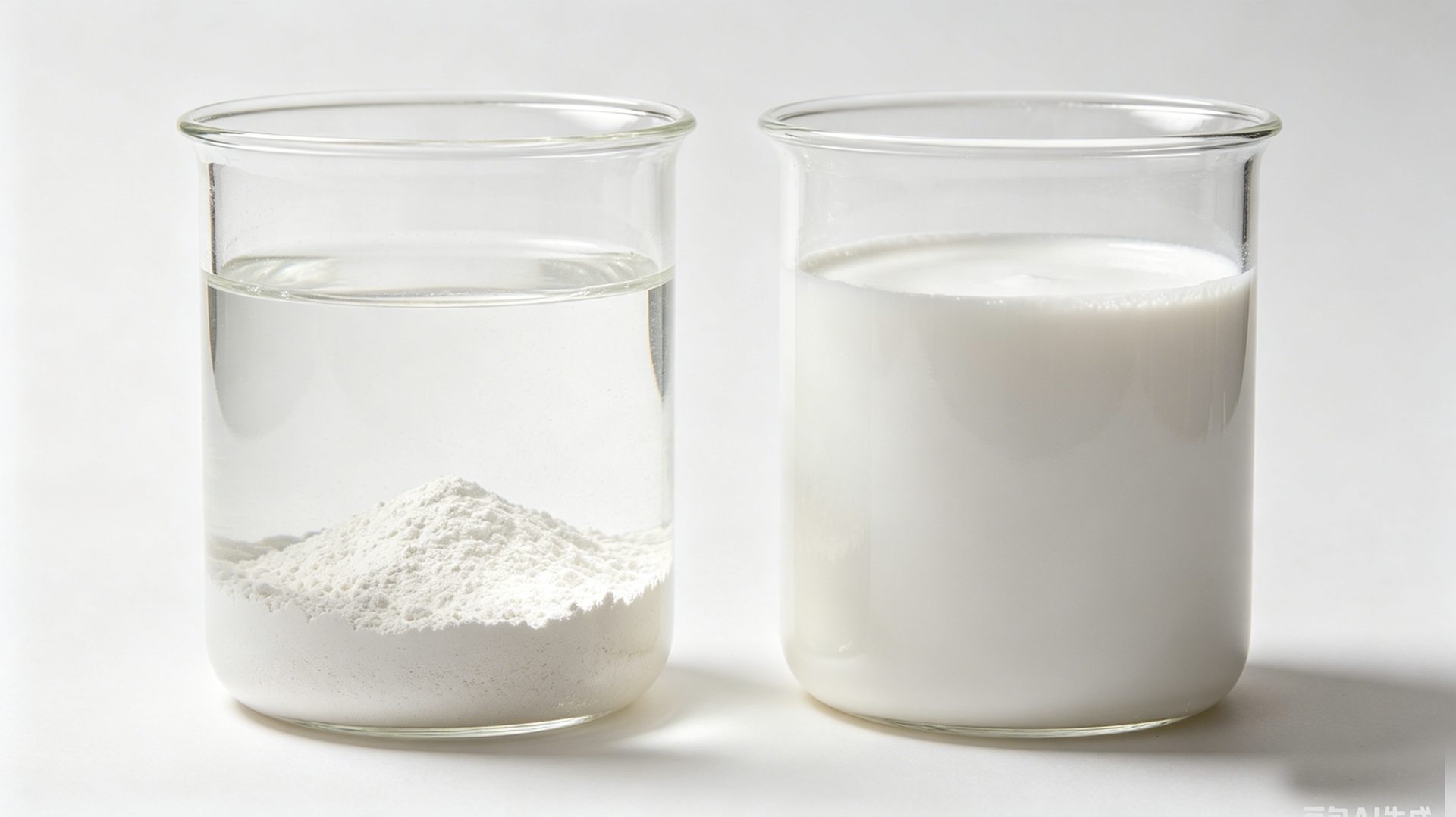
Pigment settling is governed by Stokes' Law: particles with higher density than the surrounding fluid sink at a rate determined by their size, density difference, and the fluid viscosity. Iron oxide pigments (density ~5 g/cm³), titanium dioxide (~4 g/cm³), and barium sulfate (~4.5 g/cm³) are all significantly denser than typical paint vehicles (~0.9–1.1 g/cm³), making settling inevitable without rheological intervention.
Step 1: Understand Your Settling Problem
Before selecting an anti-settling additive, characterize your settling issue:
- Soft settling: Pigments sink but redisperse easily with shaking — mild anti-settling agent needed
- Hard settling (caking): Dense, difficult-to-redisperse sediment — more aggressive rheology modification required
- Flood/float: Differential settling of different pigments leading to color variation — requires uniform thixotropy
Step 2: Choose the Right Anti-Settling Agent
For solvent-based paints, organoclay is the most effective and permanent anti-settling solution:
| Paint System | Recommended Grade | Treat Rate |
|---|
| Aromatic solvent industrial coatings | CP-34 | 0.3–1.0% |
| Aliphatic solvent architectural coatings | CP-40 | 0.3–0.8% |
| High-solid / VOC-compliant coatings | CP-180B (SA) | 0.2–0.7% |
| Waterborne coatings | CP-EW | 0.5–1.5% |
Step 3: Disperse Organoclay Correctly
- Add organoclay to the solvent phase before adding resins or binders
- Add polar activator (95% ethanol) at 30–50% by weight of organoclay
- Mix at high shear (1,000–3,000 rpm) for 10–15 minutes
- Allow 10 minutes rest for gel network development
- Proceed with normal paint grinding/let-down
Step 4: Evaluate Anti-Settling Performance
Test using ASTM D869 (settling resistance test) or accelerated testing at 50°C for 7 days. Properly formulated organoclay-containing paint should show soft settling rating ≥6 after 30 days at ambient temperature.
For more detail, see our Anti-Settling Solution page and anti-settling agent knowledge article.
Frequently Asked Questions
What causes settling in paint?
Settling is driven by density differences between pigment particles and paint vehicle (Stokes law). Dense pigments — barium sulfate (SG 4.3), iron oxide (SG 5.1), TiO₂ (SG 3.9) — sink through the lighter vehicle (SG ~0.9–1.2). Accelerated by high storage temperature (lowers vehicle viscosity), large particle size, and absence of structured rheology. Organoclay at 0.3–1.0 wt% builds sufficient yield point to prevent settling of all common pigments.
What are anti settling additives in paint?
For solvent-based coatings: organoclay (best — platelet gel network, thermally stable, dual anti-settling + anti-sagging); fumed silica (good but hazy in clear coatings); polyamide wax (temperature-sensitive, melts above 85°C). For waterborne coatings: HEUR/HASE polymers, fumed silica, CP-EW water-dispersible organoclay. Organoclay is the standard for solvent-based industrial coatings.
Anti-settling agent guide → How much organoclay to prevent pigment settling?
Light pigments (TiO₂) at PVC 20–30%: 0.2–0.4 wt%. Mixed pigment/filler systems: 0.3–0.6 wt%. Dense pigments (BaSO₄, Fe₂O₃): 0.5–1.0 wt%. Anti-corrosion primers (Zn-rich): 0.8–1.5 wt%. Target TI ≥ 3.5 for light pigments; TI ≥ 5.0 for dense pigment systems. Adjust dosage until target achieved.