Construction Applications Overview
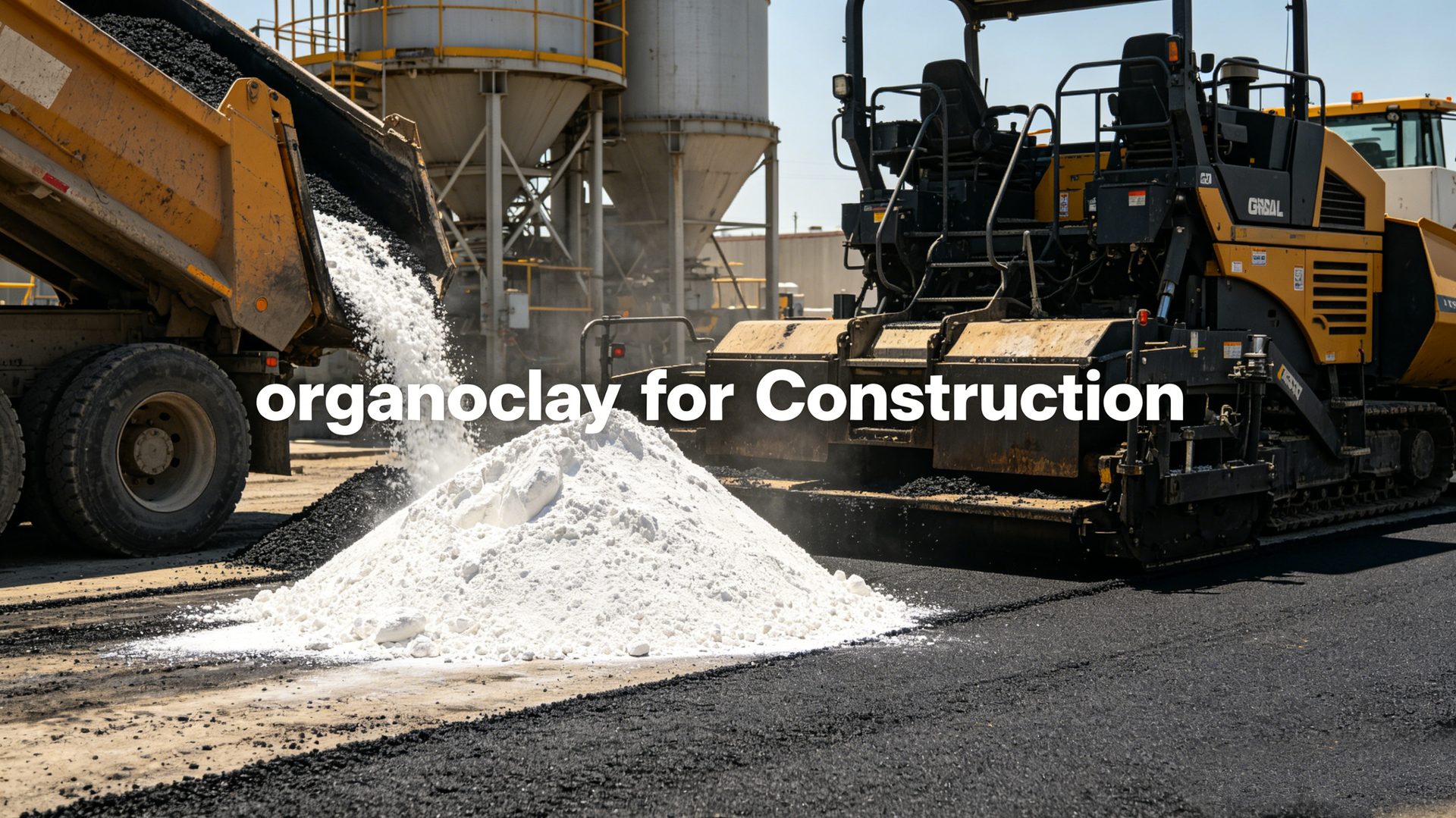
Organoclay in construction: A thixotropic rheology modifier for asphalt, bituminous coatings, and construction chemical formulations. In asphalt/bitumen, organoclay platelets restrict molecular chain mobility at high temperature — improving rutting resistance without compromising low-temperature flexibility. In waterproofing coatings, it prevents sag on vertical and sloped surfaces at 0.5–2.0 wt% treat rate.
| Construction Application | Organoclay Function | Grade | Dosage |
|---|
| Hot-mix asphalt / polymer-modified bitumen (PMB) | Rutting resistance; high-temp stiffness improvement; nano-reinforcement | CP-34, CP-40 | 2–5% by bitumen wt |
| Cutback asphalt (aromatic solvent) | Viscosity modification; anti-settling | CP-34, CP-40 | 0.5–2.0% |
| Bituminous waterproof coatings (foundation, roof) | Anti-sag on vertical surfaces; anti-settling; adhesion | CP-34, CP-40, CP-EZ10 | 0.5–2.0% |
| Coal tar pitch coatings (underground pipe) | Anti-sag; anti-drip; body | CP-34 | 0.5–2.0% |
| Elastomeric waterproof membranes (PU/acrylic) | Sag resistance on sloped roofs; filler suspension | CP-APA, CP-34 | 0.5–1.5% |
| Road marking paints | Anti-settling of glass beads and pigments; sag resistance | CP-34, CP-40 | 0.5–1.5% |
| Construction sealants (PU, silicone, polysulfide) | Non-sag on vertical joints; filler suspension | CP-APA, CP-34, CP-EL | 1.0–2.5% |
| Tile adhesives (solvent-based) | Non-sag; thixotropy during application | CP-34, CP-APA | 0.5–1.5% |
Asphalt and Bitumen Modification
Why Modify Asphalt with Organoclay?
Standard paving-grade asphalt is temperature-susceptible — soft and prone to rutting at high summer pavement temperatures (60–70°C), brittle and prone to cracking at cold winter temperatures. Organoclay addresses the high-temperature side:
- Increases high-temperature dynamic shear stiffness (G*/sin δ at 64°C+) — SuperPave rutting parameter
- Improves permanent deformation resistance without polymer modification cost
- Can be used as co-modifier with SBS or SBR polymers — organoclay provides nano-reinforcement while polymers provide elasticity
- Thermal stability at mixing temperature (150–180°C) — organoclay degrades above ~200°C organic modifier, but performs well at asphalt mixing temperatures
Mechanism in Hot-Mix Asphalt
- Add organoclay (2–5% by bitumen weight) to hot bitumen at 150–180°C under high shear
- Clay platelets exfoliate and disperse in the bitumen molecular matrix
- Intercalated platelets restrict mobility of bitumen asphaltene and maltene fractions
- Result: increased high-temperature stiffness and viscosity → reduced rutting at service temperature
Asphalt System Grade Selection
| Asphalt System | Temperature | Grade | Dosage |
|---|
| Hot-mix asphalt / PMB (150–180°C processing) | High | CP-34, CP-40 | 2–5% by bitumen wt |
| Cutback asphalt (aromatic solvent) | Ambient | CP-34, CP-40 | 0.5–2.0% |
| Bituminous roof coating | Ambient | CP-34, CP-40, CP-EZ10 | 0.5–2.0% |
| Coal tar pitch coating (underground) | Elevated | CP-34 | 0.5–2.0% |
Bituminous Waterproof Coatings
Applied by brush, roller, or spray to foundation walls, roofs, bridge decks, and tunnel linings — these coatings must resist sag on vertical and sloped surfaces while maintaining good film build and adhesion:
- Anti-sag: Organoclay at 0.5–2.0% prevents applied coating from running on vertical foundation walls before curing
- Anti-settling: Maintains uniform bitumen/filler distribution in stored product and during application
- Film build: Allows application of thicker dry film in a single coat on vertical surfaces
- Improved adhesion: Clay platelet alignment in cured film improves adhesion and barrier performance to concrete
Frequently Asked Questions
What is organoclay used for in construction?
Organoclay is used as a rheology modifier in polymer-modified bitumen (2–5% by bitumen weight, improves rutting resistance); bituminous waterproof coatings (0.5–2.0%, anti-sag on vertical surfaces); construction sealants (1.0–2.5%, non-sag on vertical joints); road marking paints (0.5–1.5%, anti-settling of glass beads); and coal tar pipe coatings (0.5–2.0%, anti-drip on overhead pipes).
How does organoclay improve asphalt rutting resistance?
Added at 2–5% by bitumen weight at 150–180°C under high shear, organoclay platelets exfoliate and disperse in the bitumen matrix. The intercalated platelets restrict molecular chain mobility of bitumen components at high temperature — increasing G*/sin δ (SuperPave high-temperature rutting parameter) without compromising low-temperature performance. Can be used alone or as a co-modifier with SBS/SBR polymers.
What is the difference between bentonite and organoclay in construction?
Bentonite (hydrophilic) is used in water-based construction systems: slurry walls, groundwater cut-off barriers, and water-swelling gaskets — it seals by swelling when contacted by water. Organoclay (organophilic) is used in non-aqueous construction systems: asphalt/bitumen, solvent-based waterproof coatings, and construction sealants — where oil or solvent compatibility is required and water swelling would be detrimental.
What is dry mortar used for?
Dry mortar is factory-blended sand + binder + additives, mixed with water on site. Used for: tile adhesives (bonding ceramic/stone tiles), plastering (interior/exterior wall finishes), repair mortars, self-leveling compounds, and EIFS systems. Water-dispersible organoclay or purified bentonite can be added to dry mortar formulations to improve workability, water retention, and fresh mortar sag resistance.
Which organoclay grade is best for asphalt modification?
For hot-mix asphalt and PMB at 150–180°C: CP-34 or CP-40 (thermally stable, broad polarity, compatible with bitumen). For cutback asphalt (aromatic solvent base): CP-34 or CP-40. For bituminous roof coatings at ambient temperature: CP-34, CP-40, or CP-EZ10. Dosage: 2–5% by bitumen weight for PMB; 0.5–2% for coatings. Contact our technical team for specific dosage optimization for your bitumen grade and target performance.
Recommended grades for construction: CP-300A (refractory castables, clean burnout) ·
CP-34 (bituminous & waterproofing coatings) ·
THICKENT Y5/Y7 (HPMC replacement for mortar) ·
THICKENT W (dual aqueous/solvent system)
Related pages: Construction Sealants ·
Anti-Settling Agent Guide ·
High Temperature Stability