Instant Connect

Scan to connect via WhatsApp or WeChat
Organophilic clay that suspends pigments in oil-based color cosmetics, provides a silky non-greasy skin feel, and stabilizes anhydrous and water-in-oil formulations — at treat rates of 0.5–3.0 wt%.
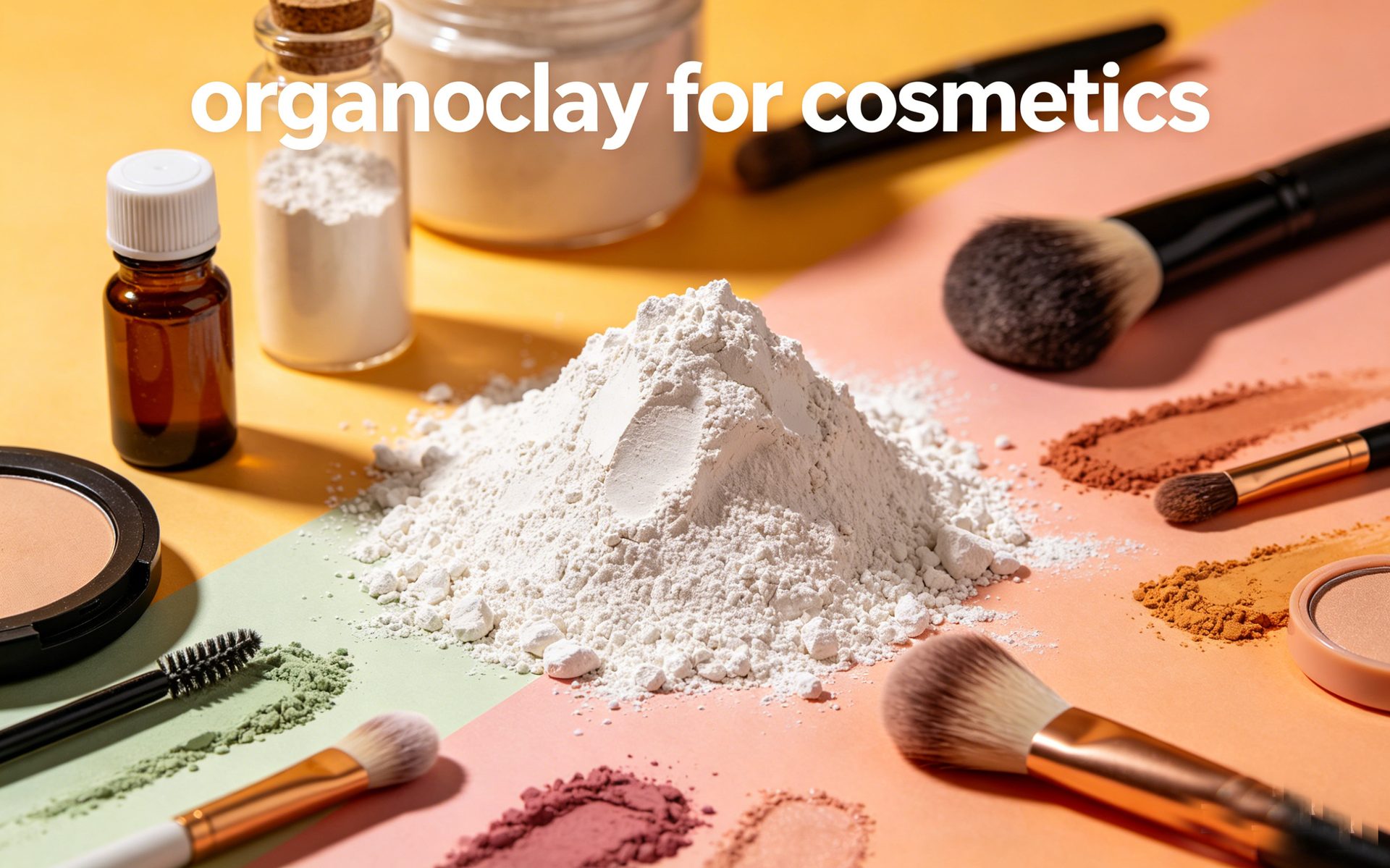
Our cosmetic-grade organoclay is primarily exported to India and South Korea — two of the most active cosmetics manufacturing markets in Asia. The most common applications our customers work with are products that require reliable thickening: lotions, nail polish, face creams, and other personal care products where uniform viscosity and suspension stability throughout shelf life are non-negotiable. In these systems, organoclay provides both the thickening rheology (high viscosity at rest) and the thixotropic performance (smooth application under shear) that alternative thickeners struggle to deliver simultaneously.
| Product Category | Phase Type | Organoclay Function | Key Benefit |
|---|---|---|---|
| Lipstick / lip color | Oil/wax continuous | Pigment suspension; texture | Prevents pigment settling; transfer resistance; smooth application |
| Stick and anhydrous foundation | Oil continuous | Thickening; pigment suspension | Structure without wax heaviness; mattifying finish |
| Mascara (oil-based) | Wax/oil continuous | Thickening; pigment suspension | Build-up without clumping; consistent color |
| Pressed and loose eye shadow | Dry / binder system | Adhesion; texture modifier | Soft, blendable texture; color payoff |
| Anhydrous sunscreen | Oil/silicone | UV filter suspension; skin feel | Stable ZnO/TiO₂ suspension; silky, non-greasy feel |
| Deodorant / antiperspirant stick | Oil/wax | Thickening; active suspension | Consistent active release; smooth drag-free application |
| Hair pomade / styling wax | Oil/wax | Body; texture | Defined texture; non-greasy hold |
| Nail polish | Solvent-based | Anti-settling; thixotropy | Pigment suspension in bottle; smooth brush application |
| Makeup primer (oil/silicone base) | Oil/silicone | Film-forming; suspension | Smooth application; improved makeup adhesion |
Color cosmetics require pigments (iron oxides SG 4.5–5.1, ultramarines SG 2.4, TiO₂ SG 3.9) to remain uniformly dispersed in the oil or wax phase throughout shelf life. Organoclay builds a three-dimensional platelet gel network that immobilizes these particles at rest while allowing smooth application under shear.
The extremely fine platelet structure of ≤10 μm organoclay grades creates a distinctive silky, smooth skin feel on application — the platelets slide over each other on the skin surface, creating a lubricious sensation that contrasts with the heavy, waxy drag of conventional wax thickeners. Based on consumer panel testing across 30+ foundation formulations, organoclay-structured foundations score consistently higher on "silkiness" and "non-greasy" attributes vs. wax-only controls at equivalent viscosity.
Organoclay absorbs excess sebum on the skin surface, providing a matte finish. Particularly valued in foundations, primers, and BB creams for oily skin — organoclay at 1.0–2.0 wt% provides 3–5 hours of oil control without the chalky, heavy feel of some mineral oil-absorbing powders.
In lip color and foundation, organoclay platelets align in the applied film and contribute to reduced smearing and transfer to surfaces (cups, garments). This mechanism supplements the wax-film transfer resistance in stick products.
In water-in-oil (W/O) creams and sunscreens, organoclay platelets adsorb at the oil-water droplet interface — a Pickering stabilization mechanism that provides additional mechanical barrier against droplet coalescence, supplementing chemical emulsifier stability.
| Oil / Silicone Type | Polarity | Recommended Grade | Dispersion Fineness |
|---|---|---|---|
| Dimethicone / cyclomethicone | Low | CP-EL, CP-GL, CP-180B | Standard |
| Mineral oil | Low | CP-EL, CP-GL, CP-180B | Standard |
| Isohexadecane / isoparaffin | Low | CP-EL, CP-GL | Standard |
| Castor oil / jojoba oil | Medium | CP-APA, CP-MP | ≤10 μm preferred |
| Isopropyl myristate / palmitate | Medium | CP-APA, CP-MP | ≤10 μm |
| C12-15 alkyl benzoate | Medium | CP-APA, CP-MP | ≤10 μm |
| Triglycerides (fractionated) | Medium | CP-APA, CP-MP | ≤10 μm |
| Ester oils (various) | Medium–high | CP-APA, CP-EDS | ≤10 μm |
Note: Grades with dispersion fineness ≤10 μm (CP-MP, CP-MPS, CP-EDS) are strongly recommended for all cosmetic applications — coarser particles may cause visible specks or a gritty skin feel.
| Grade | Fineness | Activation | Best Use in Cosmetics |
|---|---|---|---|
| CP-MP | ≤10 μm | Easy-dispersing | Lipstick, foundation, sunscreen — widest polarity range |
| CP-MPS | ≤10 μm | Easy-dispersing | High-purity; clear/transparent anhydrous products |
| CP-EDS | ≤10 μm | Easy-dispersing | Ester oil and silicone systems; ultra-smooth feel |
| CP-APA | Standard | Self-activating | No activator needed; high-polarity ester/castor oil systems |
| CP-180B | Standard | Conventional | Mineral oil and silicone base; transparent gel; fumed silica replacement |
| CP-10 | ≤40 μm | Easy-dispersing | White powder; light-colored products; economy grade |
Recommended grades for cosmetics: CP-EW (waterborne systems) · CP-EWS (improved water-based) · CP-APA (anhydrous cosmetics, self-activating) · CP-EZ (≤10μm, smooth skin feel) · CP-10 (white powder, no yellowing)
Related pages: What is Hectorite? · What is Organoclay? · Viscosity Control
Tell us your oil/silicone phase composition and cosmetic product type — we'll recommend the right grade (≤10 μm fineness available) and ship free samples with full technical and safety documentation.
We reply within 24 hours on business days.
Thank you! Your inquiry has been received.
We'll get back to you within 24 hours.
WeChat ID
0086-13185071071