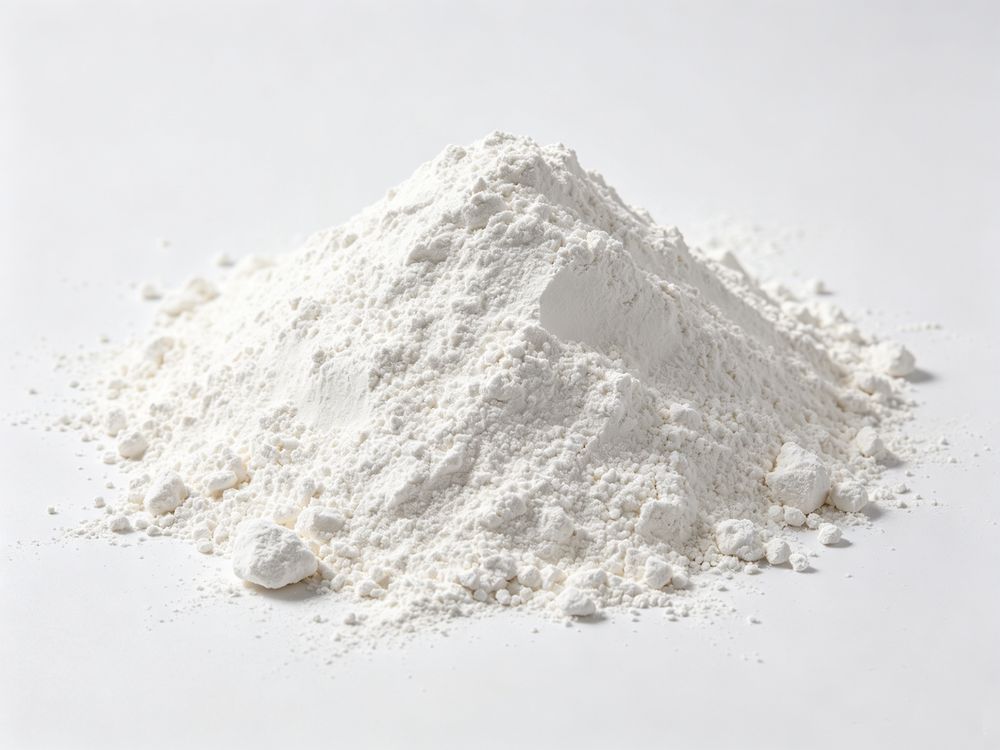
CP-10 is a self-activating organophilic clay delivering fine dispersion (≤40 μm), light-colored gel, and easy incorporation across a broad range of non-polar to medium-polarity solvent systems. The white powder appearance and high-clarity gel make it suitable for light-tinted and pastel coatings, high-gloss systems, and appearance-sensitive applications where yellowing or cloudiness from the rheology additive is not acceptable. Direct powder addition without polar activator simplifies the manufacturing process and eliminates activator-related VOC contribution.
Technical Properties
| Parameter | Specification | Test Method |
|---|
| Chemical composition | Organic derivative of montmorillonite clay | — |
| Appearance | Fine powder, white | Visual |
| Moisture content | ≤ 3.5% | 105°C, 2 hours |
| Loss on ignition (LOI) | 30–34% | 1000°C |
| Bulk density | 0.35–0.45 g/cm³ | — |
| Fineness | ≥ 98% passing 74 μm (200 mesh) | Sieve analysis |
| Dispersion fineness | ≤ 40 μm | Hegman/fineness gauge |
| Activation | Self-activating — no polar activator required | — |
Performance Characteristics
- High efficiency — builds effective gel network at 0.2–1.0% without polar activator; comparable to activated conventional organoclay at similar dosage in polar systems
- Light-colored, high-clarity gel — white powder produces minimal yellowing or cloudiness in light-tinted formulations
- No pre-gel required — direct powder addition before grinding; no additional processing step
- Eliminates polar activator — no ethanol or methanol addition; reduces VOC contribution and simplifies production
- Consistent rheology development — predictable thixotropy across production batches
- Post-correction capability — adjust viscosity after formulation without batch rejection
- Fine dispersion fineness ≤40 μm — smooth, homogeneous texture for quality-sensitive applications
Applications and Dosage
| Application | Typical Dosage | Key Advantage of CP-10 |
|---|
| Solvent-based paints (light tints) | 0.3–1.0 wt% | White powder — no yellowing in light-tinted systems |
| Putty and surface filler | 0.5–2.0 wt% | Non-sag, workability, easy direct addition |
| Sealants and adhesives | 0.5–2.0 wt% | Self-activating, no activator required |
| Printing ink | 0.5–2.0 wt% | Fine dispersion ≤40 μm — no plate abrasion |
| Cosmetics (anhydrous) | 1.0–5.0 wt% | White, high clarity — color-neutral in cosmetics |
| Nano-composites | 1.0–10 wt% | Self-activating dispersion in polymer systems |
White vs Light-Yellow Organoclay: CP-10 is specified as a white powder, making it preferable over light-yellow grades (CP-34, CP-180B) for white or light-tinted paints, white cosmetics, and natural-color adhesives where the yellowing of light-yellow organoclay is visually unacceptable. For maximum gel efficiency in aromatic systems where color is not critical, CP-34 with activation remains the higher-performance choice.
Incorporation Method
- Add CP-10 as dry powder before the grinding stage — grinding shear aids complete exfoliation
- No polar activator required in most solvent systems; optional 20–30% ethanol can improve performance in aliphatic/low-polarity systems
- Disperse at high shear (1,500–2,500 rpm) for 10–15 minutes
- Proceed with normal formulation sequence — add pigments, fillers, and binders
- Post-correct viscosity after full formulation if needed
Frequently Asked Questions
What is CP-10 organoclay used for?
CP-10 is used as a self-activating rheology modifier in solvent-based paints (particularly light-tinted formulations where white powder color is preferred), putty, sealants and adhesives, printing inks, anhydrous cosmetics, and nano-composites. At 0.2–1.0% with direct powder addition, it builds anti-settling, anti-sagging, and thixotropic consistency without polar activator or pre-gel step.
How does CP-10 compare to CP-APA?
Both CP-10 and CP-APA are self-activating organoclay grades with similar LOI ranges. CP-10 is specified as white powder (vs CP-APA off-white) and carries a specific dispersion fineness specification (≤40 μm). Both eliminate the polar activator step. Choose CP-10 when white color is important for light-tinted formulations; choose CP-APA when maximum gel strength in high-polarity ketone/ester systems is the priority.
CP-APA details → Can CP-10 be used in waterborne systems?
No. CP-10 is organophilic and will not disperse in water. Adding CP-10 to a waterborne formulation results in agglomeration and loss of rheological function. For water-based systems — waterborne paints, emulsion coatings, water-based cosmetics — use
CP-EW, which is specifically modified for aqueous dispersibility.
Packaging and Storage
| Parameter | Specification |
|---|
| Standard packaging | 25 kg kraft paper bags with PE inner liner |
| Shelf life | 2 years from manufacture date |
| Storage conditions | Cool, dry, well-ventilated warehouse; avoid moisture exposure |
Related grades: CP-APA (self-activating, off-white) ·
CP-26 (self-activating, economical) ·
CP-34 (highest gel strength, requires activator) ·
CP-EW (water-based systems)
Related applications: Paint & Coatings ·
Sealants & Adhesives ·
Printing Ink ·
Cosmetics