Instant Connect

Scan to connect via WhatsApp or WeChat
Organoclay is the standard anti-settling agent for solvent-based industrial coatings — prevents pigments and fillers from forming hard sediment during storage, while maintaining easy application and good leveling.
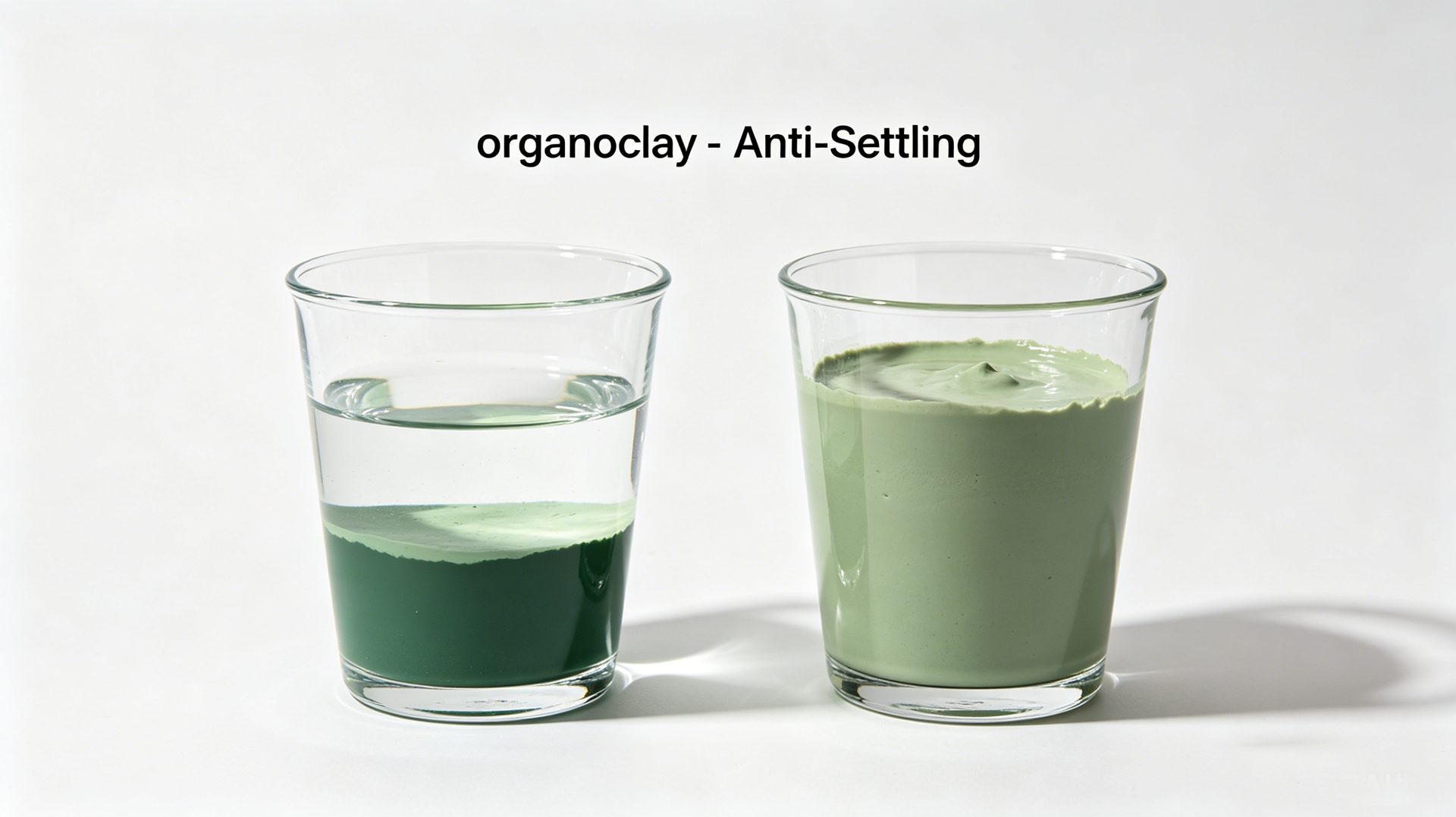
Settling follows Stokes' Law — the settling velocity of a particle is proportional to the square of its diameter and the density difference between the particle and the medium. Dense pigments settle rapidly in low-viscosity paint vehicles:
| Pigment / Filler | Specific Gravity | Relative Settling Tendency |
|---|---|---|
| Barium sulfate (BaSO₄) | 4.3 | Very high |
| Iron oxide red (Fe₂O₃) | 5.1 | Very high |
| Zinc phosphate | 3.9 | High |
| Titanium dioxide (TiO₂) | 3.9 | High |
| Calcium carbonate (CaCO₃) | 2.7 | Moderate |
| Talc | 2.7 | Moderate |
| Typical paint vehicle (solvent + resin) | 0.8–1.2 | Reference |
Settling is worsened by: high storage temperature (reduces vehicle viscosity); large pigment particle size; long storage time; and absence of structured rheology in the paint vehicle.
When dispersed in the paint at 0.3–1.0 wt%, organoclay platelet particles (1 nm thick, 200–500 nm wide) form a three-dimensional "house-of-cards" gel network through edge-to-face electrostatic interactions:
| Additive Type | System | Anti-Settling Effectiveness | Anti-Sagging | Temperature Stability | Transparency |
|---|---|---|---|---|---|
| Organoclay | Solvent-based | Excellent | Excellent | Excellent (to 180°C) | Good–Excellent (fine grades) |
| Fumed silica | Solvent + water | Good | Good | Good | Poor (hazy) |
| Polyamide wax | Aliphatic solvents | Good | Good | Poor (melts <85°C) | Poor |
| Hydrogenated castor oil | Solvent-based | Moderate | Moderate | Poor (melts) | Poor |
| CP-EW (water-dispersible) | Waterborne | Good | Moderate | Good | Good |
| Coating System | Pigment Load | Recommended Grade | Typical Dosage |
|---|---|---|---|
| Aromatic solvent (xylene, toluene), industrial | Standard to heavy | CP-34, CP-40 | 0.3–1.2 wt% |
| Aliphatic + aromatic blend | Standard | CP-10, CP-26, CP-100 | 0.3–0.8 wt% |
| High-solid / self-activating requirement | Any | CP-180B, CP-APA | 0.3–1.0 wt% |
| Ketone / ester systems (MEK, butyl acetate) | Standard | CP-APA, CP-MP | 0.3–0.8 wt% |
| Transparent coatings, clear lacquers | Light (flatting agent) | CP-MP, CP-MPS, CP-EDS (≤10 μm) | 0.2–0.6 wt% |
| Heavy pigment primer (BaSO₄, Fe₂O₃, ZnPO₄) | Heavy (>30 vol%) | CP-34, CP-APA | 0.6–1.5 wt% |
| Waterborne coatings | Any | CP-EW | 0.5–1.5 wt% |
| Pigment Type & PVC | Starting Dosage (CP-34) | Target Thixotropic Index |
|---|---|---|
| Light pigments (TiO₂) at PVC 20–30% | 0.2–0.4 wt% | ≥ 3.5 |
| Mixed pigments at PVC 20–35% | 0.3–0.6 wt% | ≥ 4.0 |
| Dense pigments (BaSO₄, Fe₂O₃) at PVC 25–40% | 0.5–1.0 wt% | ≥ 4.5 |
| Anti-corrosion primer (Zn-rich, ZnPO₄) at PVC 30–50% | 0.8–1.5 wt% | ≥ 5.0 |
Related pages: Organoclay for Paint & Coatings · Viscosity Control in Coatings · How to Prevent Pigment Settling in Paint · What is a Thixotropic Agent? · Organoclay vs Fumed Silica
Tell us your solvent system, pigment loading, and target storage stability — we'll recommend the right grade and ship free samples within 48 hours.
We reply within 24 hours on business days.
Thank you! Your inquiry has been received.
We'll get back to you within 24 hours.
WeChat ID
0086-13185071071