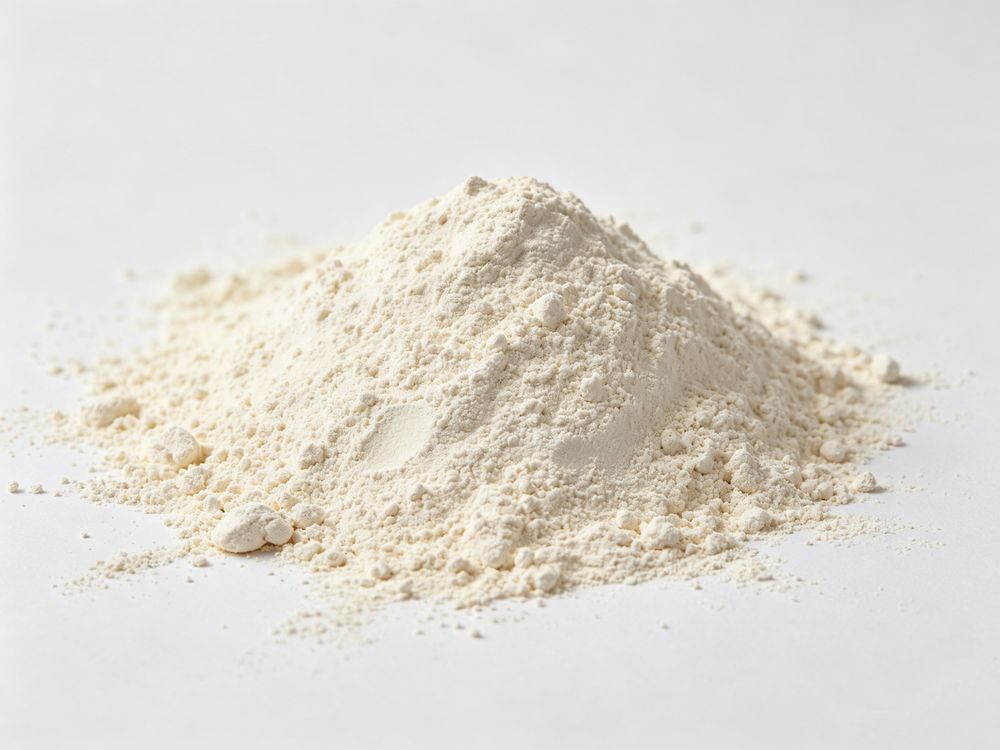
CP-250 (ink grade) is a purified and modified organophilic clay engineered for the rheological demands of printing ink formulations. With high LOI (35–38%), CP-250 develops effective gel structure in low to medium solvent printing ink vehicles — planographic offset inks, news inks, and gravure inks — without requiring a polar activator addition step that would complicate ink manufacturing and potentially disrupt pigment dispersion or drying balance. High gelling efficiency provides the thixotropy, anti-settling, and body required for consistent print quality across high-speed press operations.
Technical Properties
| Parameter | Specification | Test Method |
|---|
| Chemical composition | Organic derivative of montmorillonite clay (purified) | — |
| Appearance | Fine powder, light yellow | Visual |
| Moisture content | ≤ 3.5% | 105°C, 2 hours |
| Loss on ignition (LOI) | 35–38% | 1000°C |
| Fineness | ≥ 98% passing 74 μm (200 mesh) | Sieve analysis |
| Activation (ink use) | No polar activator required | — |
Target Printing Ink Applications
| Ink Type | Typical Dosage | Key Function |
|---|
| Planographic (offset lithographic) ink | 0.5–2.0 wt% | Anti-settling, tack, thixotropic body |
| News ink (newspaper) | 0.5–1.5 wt% | Anti-settling in mineral oil vehicle, body |
| Gravure printing ink | 0.5–2.0 wt% | Anti-settling, viscosity profile |
| Wood coating (clear) | 0.3–1.0 wt% | Anti-settling, anti-sag in wood finish |
Ink-Specific Advantage: Conventional organoclay grades (CP-34, CP-APA) require polar activator addition that introduces additional polar solvent into the ink vehicle — potentially disrupting pigment wetting balance, affecting drying speed, and requiring reformulation of the ink system. CP-250's activator-free incorporation keeps the ink vehicle composition unchanged, making it a drop-in rheology additive for ink reformulation without system-wide adjustment.
Incorporation Method
Ink Applications
- Add CP-250 directly to the ink vehicle (no polar activator, no heating required)
- Add at 0.2–2.0% of total formulation weight
- Disperse under high-shear mixing — grinding mill or high-speed dispenser
- Prolong dispersion time for better gel performance — extended grinding shear improves platelet exfoliation
- Verify final ink rheology (viscosity, tack, body) before pigment addition if making pre-base
Frequently Asked Questions
What printing inks is CP-250 designed for?
CP-250 is designed for planographic (offset lithographic) inks — oil-based mineral oil/alkyd varnish inks; news inks (newspaper printing) — mineral oil-based high-speed press inks; and gravure printing inks — solvent-based rotogravure inks. No polar activator required in any of these ink types. Also used in wood coatings at 0.3–1.0%.
Full ink application guide → Why does CP-250 not require a polar activator for ink applications?
CP-250's high LOI (35–38%) provides higher organic modifier loading that enables spontaneous gel development in printing ink vehicles (mineral oils, alkyd varnishes) without external polar activator. This is critical for ink formulations that cannot tolerate additional polar solvents — adding ethanol or methanol activator would disrupt pigment wetting, alter drying performance, and require reformulation of the entire ink system. CP-250 provides activator-free incorporation as a drop-in additive.
Can CP-250 be used in digital or UV-curable inks?
CP-250 is designed for conventional oil-based and solvent-based inks. For UV-curable systems, polarity compatibility must be evaluated — UV monomers/oligomers differ significantly from mineral oil ink vehicles. For UV-curable applications,
CP-388 or
CP-EZ with wider polarity range may be more suitable. Contact our technical team with your UV ink composition for a specific recommendation.
Packaging and Storage
| Parameter | Specification |
|---|
| Standard packaging | 25 kg kraft paper bags with PE inner liner; 22.68 kg bags available |
| Shelf life | 2 years from manufacture date |
| Storage conditions | Cool, dry, well-ventilated warehouse; avoid moisture |
Related grades: CP-34 (general purpose with activator) ·
CP-EZ (ultra-fine ≤10μm, self-activating) ·
CP-388 (high purity, wide polarity)
Related applications: Printing Ink ·
Wood Coatings